Next week Sounds Profitable and The Podglomerate present How (and Why) to Budget for Podcast Awards in 2026. This free webinar will look at how one should budget for awards, what key awards to watch for, and how podcast awards influence show and audience goals. Registration is still open, grab your virtual seat now for Thursday, December 11th, at 1:00 p.m. EST.
I’ve never cared for the term “podfade.”
The word carries this implication that stopping a podcast is somehow a failure—that the creator just couldn’t hack it, ran out of steam, or gave up. But that’s not how we talk about any other creative medium. The greatest television shows in history eventually ended. Breaking Bad didn’t “podfade.” The Wire didn’t “podfade.” Creators make deliberate decisions to conclude their work for all kinds of reasons: they told the story they wanted to tell, their life circumstances changed, or they simply moved on to the next thing. That’s not failure. That’s the natural lifecycle of creative work.
But here’s the thing—there is a real podfade problem, and it has nothing to do with individual shows ending. Take a look at this graph from our upcoming release of The Creators 2025:
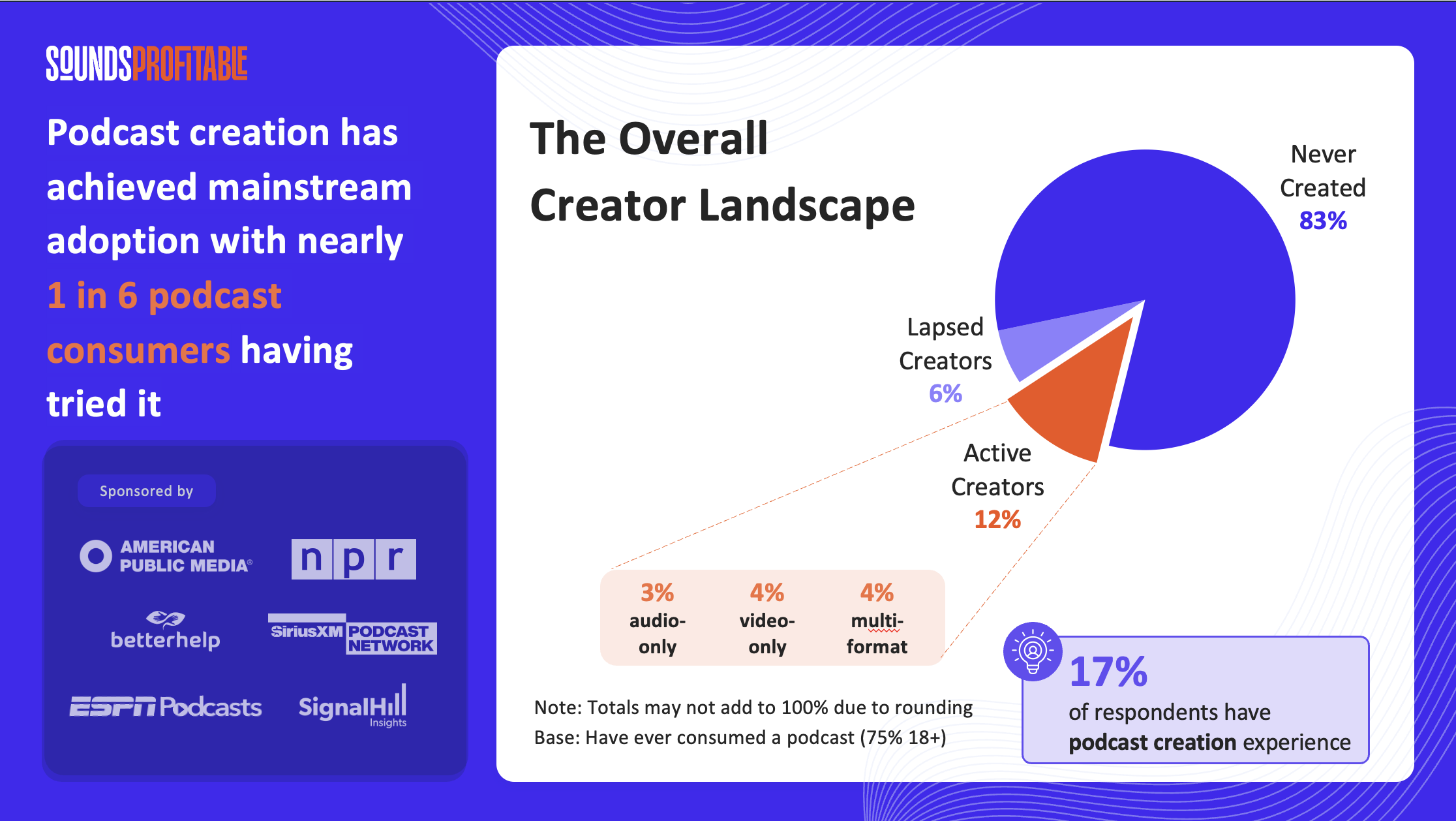
Let’s break down what we’re seeing here. Podcast creation has achieved genuine mainstream adoption—nearly 1 in 6 podcast consumers have tried their hand at making a podcast. That’s a remarkable number when you think about it. We’ve moved well beyond the era when podcast creation was the province of tech enthusiasts and radio refugees. The tools have democratized, the barriers have fallen, and people have responded.
Of those who have created, 12% are currently active creators. Another 6% are what we call “lapsed creators”—people who made podcasts at some point and have stopped entirely. Not stopped a particular show. Stopped creating.
Do the math, and roughly a third of everyone who has ever created a podcast has churned out of being a creator altogether. Now that doesn’t mean that it is a permanent condition, but still. That’s the podfade we should be talking about.
The distinction matters enormously. When someone ends Show A and starts Show B, they’re still in the ecosystem. They’re still developing skills, building audiences, experimenting with formats, and contributing to the medium. They understand podcasting from the inside. They’re advocates for the space even when they’re between projects. But when someone walks away from podcast creation entirely, we’ve lost something more fundamental—we’ve lost a voice, and we’ve lost an evangelist.
I also find the format breakdown among active creators to ring true as a snapshot of 2025: 3% audio-only, 4% video-only, and 4% multi-format. The video conversation in podcasting has become increasingly heated over the past couple of years, with some insisting that video is now mandatory and others defending audio as the “pure” form of the medium. The data suggests creators themselves are splitting roughly evenly across these approaches—which tells me the market hasn’t decided yet, and there’s room for multiple strategies to succeed.
But back to the churn question. When I look at that 6% of lapsed creators, I wonder: what happened? Did they get frustrated with the technical aspects? Did they struggle to find an audience? Did life simply get in the way? Did they discover that the fantasy of having a podcast was more appealing than the reality of making one every week?
I’ll dig into some causes in a future piece when we release the full study. For now, I just wanted to plant this flag: the “real” podfade isn’t about shows ending. It’s about creators leaving. And if we want podcasting to continue growing—not just as a listening medium, but as a creative one—we need to understand why a third of everyone who tries this eventually walks away.
More to come when The Creators 2025 drops, next Wednesday at 2PM Eastern.