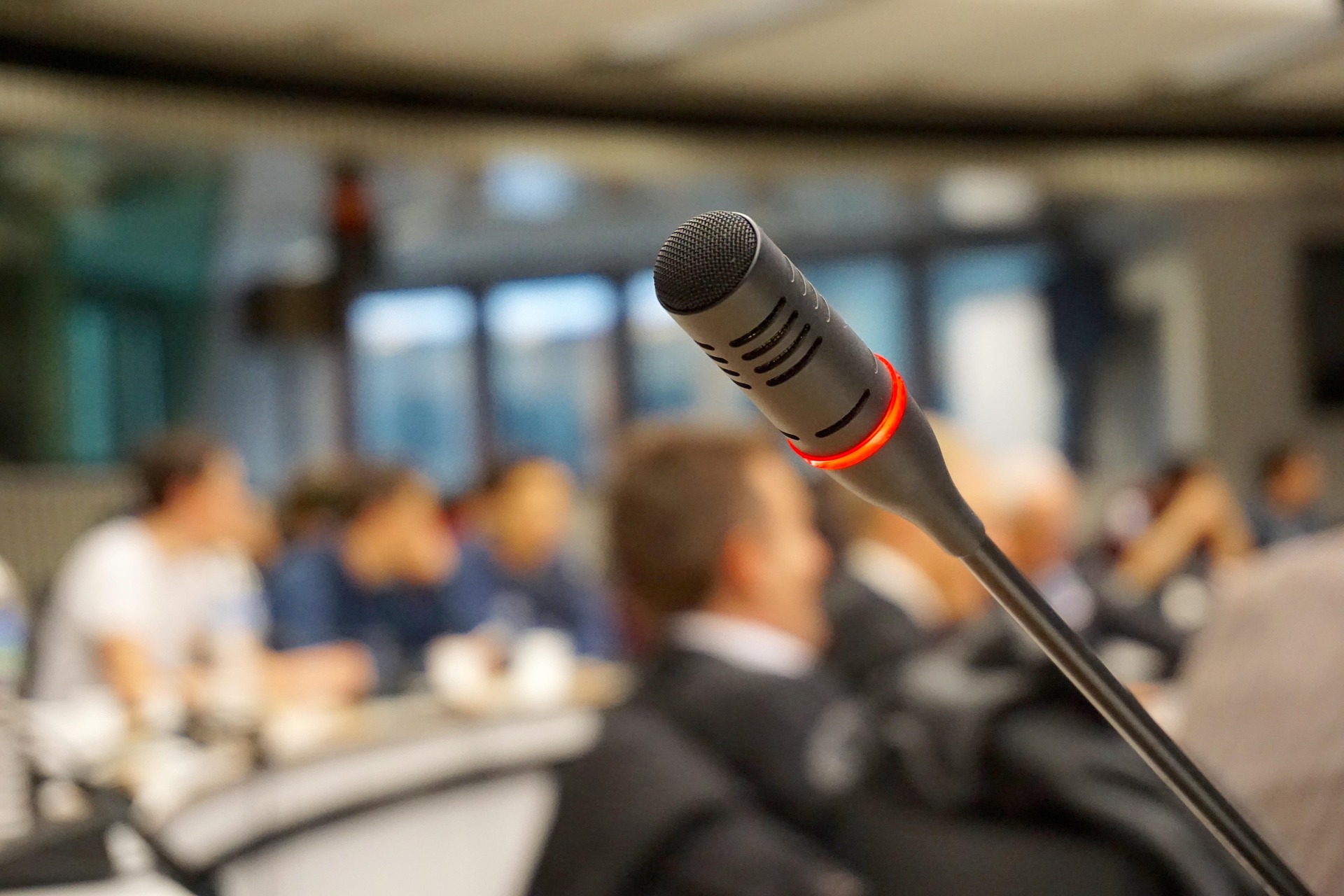
I have moderated dozens of panels over the years, which means I have also spent countless hours in airports, wondering why I keep agreeing to moderate panels. I don’t love panels. Most panels are a random collection of clips—a montage, not a movie. People leave having heard some interesting things, but they can’t quite tell you what they heard, or why it matters. The content doesn’t stick because it doesn’t fit into anything.
And yet, when someone asks me to moderate a panel, I usually say yes, because I have come to realize that a panel doesn’t have to be this way. You can build something with coherent moving parts if you approach it correctly. I just got back from moderating a panel on audio at the IAB’s annual leadership meeting in Palm Springs, and it struck me that the most important thing I’ve learned since I first started writing about moderation back in 2009 isn’t a tactic at all. It’s a strategy.
Here it is: Think of the panel as a speech you are giving. Only you’re not giving it. The panelists are.
There’s no arrogance involved here—at least, I hope not. What I mean is this: before the panel, I collect everything from the panelists. Their notes, the things they want to talk about, the questions they hope to answer, and (crucially) the things they would feel like they failed if they didn’t accomplish. Then I take all of that material and construct a narrative arc—a clear frame with a beginning, middle, and end. I’m building a talk, except I’m not the one delivering it. My job is to follow that arc and let the panelists tell the story.
What I’m really doing is constructing a vessel for their expertise to flow into. When the panel has a narrative arc, what people say on stage actually sticks, because it fits into a structure the audience can follow. They understand how each contribution slots into the larger idea. At the end of the panel, if I’ve done my job, the audience lands somewhere—some big idea, some meaningful conclusion—rather than leaving with a grab bag of unrelated anecdotes.
It’s harder to tell a story with multiple voices. I won’t pretend otherwise. But if you prepare people, if you construct that arc, you can turn a panel from a collection of short monologues into something that resembles an actual argument. The audience will remember it. They may even do something because of it.
That’s the strategy. Now for some tactics that have served me well over the years. Think of these as ways to keep your narrative arc on track and make sure the audience gets the story you’ve constructed.
Let panelists introduce themselves. You will, of course, have read their bios on your own time, but most bios are too long, awkwardly worded, and would never be read aloud by the actual panelist in question. In fact, when one of these is read on a panel, I wish I had a dollar for every time the panelist jumped in with some jokey comment, like “if only half of that were true!” They say this because these bios are not how people talk. When you ask panelists to introduce themselves, the bios they give are human-sounding and mercifully short, leaving more time for the actual discussion. The audience can read the official bios in the program if they wish.
Warm up each panelist individually before cross-panel questions. I prepare two questions for each specific panelist to knock out early. These help “warm up” the panelist by starting them in a safe place, and they ensure that everyone has contributed before the conversation opens up. Most panels have one or two personalities that, left to their own devices, would dominate proceedings, which doesn’t do your audience any favors. Never forget your role—you are the advocate for the audience, not a co-conspirator to the panelists. I never prepare questions designed to make me look smart. I prepare the questions I suspect the audience wants to hear answered. They’ll thank you for it, and (as a side benefit) you’ll look smart anyway.
Prepare dozens of questions, even if you only use five. Many audience questions turn out to be either self-serving or too highly calibrated to the individual questioner’s situation. I try to anticipate as many of these “use cases” as I can by imagining the types of people who are likely to attend and preemptively asking some of the questions they would raise. I literally write 30-50 questions in advance, knowing that I may only get to a handful of them. But when I do, they will be phrased exactly how I want them, in service of that narrative arc I’ve constructed. This also lets me move quickly—I’m not formulating questions on the fly when I could be listening to what the panelists are actually saying.
Ask specific questions, not open-ended ones. When one panelist finishes an interesting comment and you turn to another panelist and ask “what do you think about that?“—that’s a cop-out. It’s an open-ended question that allows the panelist to fill in the blank with pretty much anything they want, from a sales pitch to whatever talking points they walked in with. Instead, ask specific, pointed questions prompting a panelist to respond to something specific the previous panelist said. The more specific you are, the less likely the panel is to veer off your narrative arc into territory the audience didn’t come for.
Be merciless about protecting the audience’s time. The audience paid to be there, one way or another, and they are your responsibility. If a panelist veers off-topic or starts into a sales pitch, I am merciless. Absolutely merciless. Never be afraid to cut off windbags and quickly redirect. Your audience will love you for it, and it is the single biggest source of positive comments I get on panels I moderate. A firm but polite interruption is just the ticket.
Generally, the folks who are likely to dominate are pretty self-aware and will quickly recognize that off-topic excursions will be halted, which causes them (and the other panelists) to do a better job of self-moderating. Early in my career, I would just let these people finish, until I realized that many of them had enormous breath control.
That’s about it. The strategy is the narrative arc—think of the panel as a speech you are giving, and let the panelists deliver it. The tactics are about keeping that arc intact: warm people up, prepare obsessively, ask specific questions, and be ruthless in service of the audience. You don’t have to be antagonistic, but if you are single-minded in your determination to provide value for the audience, your choices along the way will become quite clear. At the end, if you’ve done it right, the audience won’t remember a series of clips. They’ll remember a story.
Thanks for listening to my article, A Few Notes About Fixing Conference Panels. For Sounds Profitable, I’m Tom Webster, and I’ll see you next week.
New Partners
Sounds Profitable exists thanks to the continued support of our amazing partners. Monthly consulting, free tickets to our quarterly events, partner-only webinars, and access to our 1,800+ person slack channel are all benefits of partnering Sounds Profitable.
- The Podcast Exchange (TPX) is a Canadian strategic partner for podcast advertising, leveraging deep industry expertise and research to help brands navigate the space’s unique dynamics.
- PodSEO helps podcasters optimize for discovery with data instead of guesswork.
- The Collector Nation Podcast is your front-row seat to the stories, strategy, and live action across the entire collectibles universe as the home for the hobby.
Want to learn more about partnership? Send us an email!