Before we get into this, I want to welcome the wonderful Molly DeMellier to the Sounds Profitable fold! Molly is a veteran communications pro who has plied her trade at places including Acast and Sundaze PR for over a decade and has made the fortunate (for us) decision to join our troupe. She’s handled crucial communications and PR for us in the past, and now she’ll be doing that full-time not only for Sounds Profitable, but also for our partners who choose to add her expertise to their outreach efforts. I’m really excited to see what she can do for us and the entire space in general. We need all the help we can get!
It’s the first full week of 2026, and if you’re a podcast creator, you’ve probably already seen a dozen posts about what’s “next” for the medium. More video. More clips. More cross-platform presence. More, more, more. I’d like to suggest something different: less. Not less ambition, not less quality — less chasing someone else’s idea of what podcasting should become.
Consider this my Mufasa moment, appearing in the clouds to remind you of something you already know. Minus the James Earl Jones voice, unfortunately, you’ll have to imagine that part. I tried.
Last month, we released The Creators 2025, our deep look at who’s making podcasts, who’s sticking with it, and who’s walking away. Buried in the data on lapsed creators is a format mismatch that says something important about how far the industry conversation has drifted from how people actually engage with this medium.

The creators who left podcasting look demographically like video creators — they match video creator profiles in 9 of 12 segments we measured, with a weighted similarity of 36% to video creators versus 26% to audio creators. The reasonable inference is that many of them were likely producing video podcasts. But these same lapsed creators, when we examine their consumption habits, over-index on 7 of 8 audio media types. More than half use YouTube as an audio-only experience. And when asked what they expect from podcasts, only 0.8% said video-only.
Sit with that number for a moment. Less than one percent. These creators were producing video content while preferring audio consumption — making something they themselves wouldn’t choose to engage with. The production demands of video are considerable. The reward, for most of these creators, was apparently not worth it. They burned out. They left.
This isn’t an indictment of video itself. Video works brilliantly for some shows, some creators, some audiences. But the mismatch points to something that’s been nagging at me for a while now: the industry conversation has gotten so loud about what podcasting should become that some creators have stopped trusting what podcasting actually is. I’ve been in audio for over 30 years. I’ve watched radio try to become television. I’ve watched digital audio try to become social media. And I’ve watched podcasting — this strange, intimate, trust-based medium that accidentally became the last place on the internet where people actually pay attention — start to get embarrassed by its own strengths.
The fundamentals aren’t limitations. They’re the product.
When someone puts earbuds in during their commute and chooses to spend 45 minutes with your voice, that’s not a failure to achieve scale. That’s a relationship most media would kill for. When a listener trusts your ad reads because they trust you, that’s not an artifact of a less sophisticated era. That’s the whole game. Podcasting’s core advantage has never been reach, it’s been depth. The parasocial trust that makes listeners feel they know you and believe you genuinely care about their well-being isn’t a soft metric. Our research consistently shows it’s the foundation of everything that works about this medium: audience retention, ad effectiveness, and creator sustainability. All of it flows from that relationship.
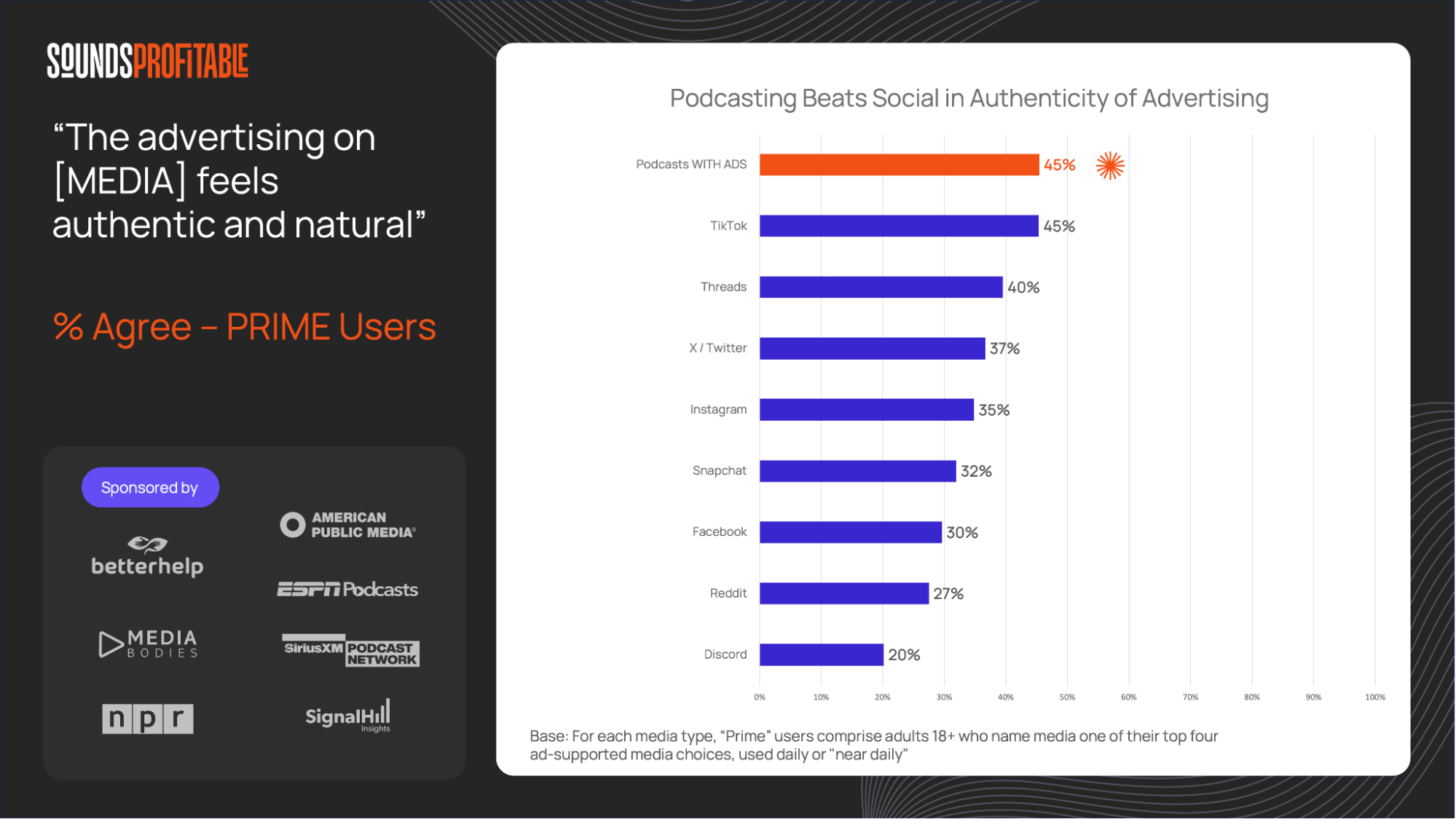
This isn’t abstract. We see it in how audiences perceive advertising across platforms. In last year’s Ad Landscape study, we asked prime users of various media whether the advertising on those platforms feels authentic and natural. Podcasts with ads came in at 45% — ahead of TikTok, YouTube with ads at 35%, Instagram, Facebook, and every other social platform in the study. The only formats that scored higher were streaming AM/FM radio and Twitch, both of which share podcasting’s emphasis on personality-driven content and direct audience relationships. The audience can tell when something is genuine. They can tell when a host actually uses the product they’re talking about, when an ad read comes from the same voice they’ve built a relationship with, and when the commercial break feels like part of the show rather than an interruption.

That perception isn’t a nice-to-have — it’s the reason podcast advertising works as well as it does. Erode the authenticity, and you erode the business model along with it.
So if the creative argument doesn’t move you, consider the commercial one. The format mismatch in our lapsed creator data illustrates what happens when the foundation gets ignored. Creators optimize for a hypothetical audience (the one the industry keeps insisting they need) instead of the actual audience they already have. They exhaust themselves producing content that doesn’t match their own instincts. They erode the authenticity that made their show work in the first place. And eventually they leave, not because podcasting failed them, but because they were convinced to build something that was never really theirs.
My suggestion for 2026 is simple: before you add anything new, reconnect with why you started. Not as nostalgia, but as strategy. What was the show you wanted to make before someone told you it needed video clips? What was the relationship you were building before you started worrying about algorithmic reach? What would you create if you trusted that the audience who found you actually wants what you’re already making?
Experimentation has its place. So does growth, and video, and clips, and cross-platform presence — for the right show, with the right resources, in service of a clear creative vision. But if you’re feeling pressure to become something you’re not, the data suggests you have permission to stop. The audience isn’t asking for reinvention. The 0.8% speaks for itself.
The creators who thrive this year will be the ones who remember what they’re protecting while they experiment—the ones who build from their foundation rather than abandoning it for someone else’s playbook. Podcasting doesn’t need to become something shinier. It needs people who still believe in what it already is.
You must take your place in the circle of life, podcasters. Remember who you are.
(vanishes into the clouds)
For the full findings on creator retention, format patterns, and what separates those who stay from those who leave, download The Creators 2025.