Reminder: SXSW is coming up fast, it’s time to register for Podcast Movement Evolutions! This year the event takes place within SXSW with no extra badge requirement or separate ticket fee. Three days of curated panels, networking, happy hours, and live events featuring special celebrity guests. All in a 400-person venue (with capacity for 350+ overflow in a neighboring space). All for free, though SXSW badge holders do receive priority access. Pre-registration is live and highly encouraged.
I was thinking about dorm room furniture the other day. I have a son in college now who is living in his first real apartment, and I remember being an undergraduate myself in the 80s with exactly zero dollars, sometimes less. Finding a way to furnish my humble dorm room was always a challenge. In Boston, of course, the furniture garbage collection day was always a big hit; in fact, we used to call it Allston Christmas for a part of town where a lot of undergrads lived, and you’d often find some questionable sofas and not-so-easy chairs on the curb, ripe for the picking. I tended to stay away from the couches because they were gateways to another world of flora and fauna, but nothing made me happier than coming upon a great stool.
I love stools. Stools are very forgiving. Unlike tables and chairs, if one of the legs is uneven, it is still a stable structure. It might have a lean, but you plop that bad boy on a generous rust-colored shag rug, and a bull couldn’t knock you over. You could eat dinner on it. And I did!
I thought about that stool when Apple announced its expanded support for video podcasts. Anytime one of the Big Three (Apple, Spotify, or YouTube) makes a move, you could be tempted to view it solely in relation to the other platforms. But that framing assumes the game is zero-sum, and that one platform is chasing the other, or playing catch-up. It isn’t. What happened is that the third leg of the stool just got sturdier. And that’s good for the whole room.
To understand why, you have to start with who Apple Podcasts actually serves, because the audiences across the three major platforms are not the same people doing the same things. They are different people (or sometimes the same people in different modes) with meaningfully different expectations for what a podcast even is. In our most recent Podcast Landscape study, we asked podcast consumers a deceptively simple question: when you think of a podcast, do you expect it to be audio or video?
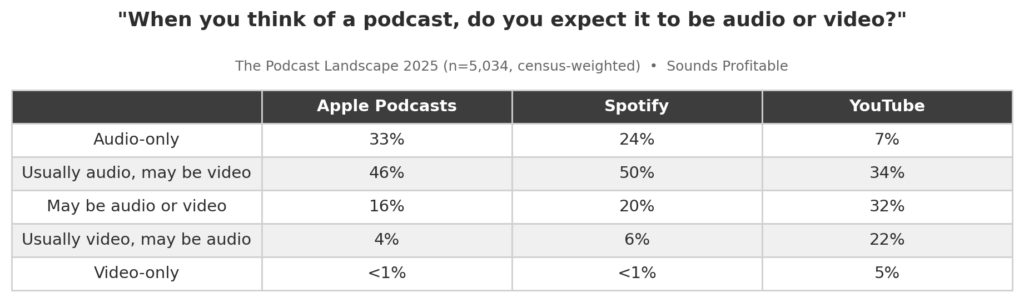
Nearly 80% of Apple Podcasts users expect their podcasts to be audio-first. Only about 4.5% lean toward video as the default. If you’re building the narrative that Apple has a “video problem,” this is probably your Exhibit A. But I think it’s actually the opposite — I think this is the most important column in this table, because it tells you something critical about Apple’s position in the ecosystem: they have the most podcast-native audience of any major platform. YouTube is designed for video first. Spotify is designed for music first. Apple Podcasts is the largest app designed from the ground up for podcasts. That matters enormously.
Now look at that 16% in the “may be audio or video” row. Those are swing voters. They’re not opposed to video; they’re open to it. They just haven’t had a reason to seek it out inside Apple Podcasts before now. With Apple’s expanded video support, that changes—and this is where the growth story begins to unfold. The demand is already there — it’s just been fulfilled elsewhere.
Here’s the data point that reframes everything. Among Apple Podcasts users who do consume video podcasts — and there are plenty of them — we asked how much of their total podcast time is spent watching video versus listening to audio.
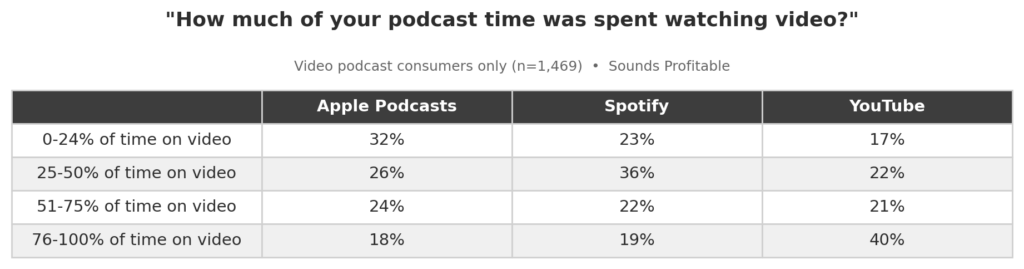
About 42% of Apple’s video podcast consumers are spending more than half their podcast time watching video. These aren’t reluctant video viewers. They aren’t people who need convincing. They already want video — they’ve just been going somewhere else to get it. That’s not a conversion challenge; it’s a plumbing problem. Apple just connected the pipes.
This matters for creators and advertisers alike, because consolidating that listening inside a single platform makes it measurable in ways that cross-platform consumption simply isn’t. When a listener toggles between Apple for audio and YouTube for video of the same show, you’re potentially counting that listener twice in two different ecosystems with two different measurement stacks. Bringing video into Apple doesn’t just improve the user experience — it cleans up the data.
The Discovery Loop
If the latent demand story is about serving existing users better, the discovery story is about how new listeners find their way into podcasts in the first place. We asked people how they discovered their favorite podcast, and the results for Apple Podcasts users are markedly different from those on the other platforms:
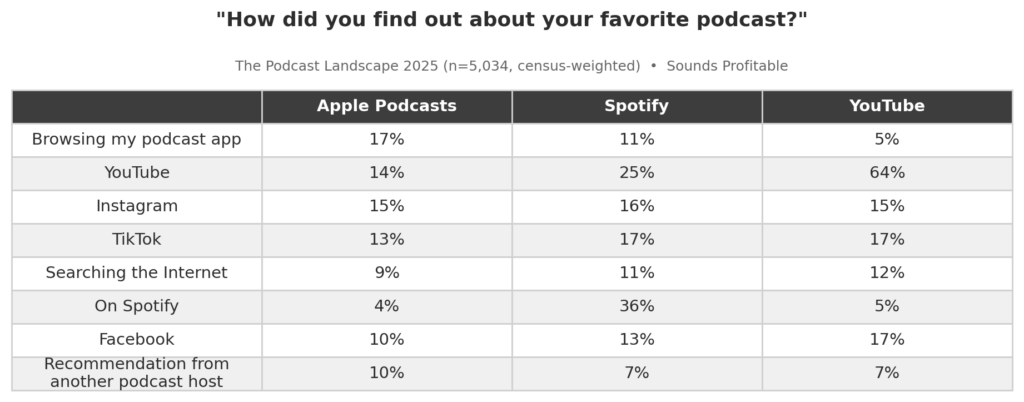
In-app browsing is still the top single source for Apple users at 17%, which tells you something about the loyalty and intent of that audience — they’re actively looking for podcasts inside a podcast app, which seems obvious but is worth noting given how much discovery on other platforms is incidental. But look at the video-native platforms: YouTube at 14%, Instagram at 15%, TikTok at 13%. These aren’t marginal numbers. Apple Podcasts users are already discovering shows through video. They’re seeing a clip on TikTok, hearing about a show in a YouTube short, scrolling past a Reel on Instagram — and then (hopefully) opening Apple Podcasts.
Until now, when they got there, they found audio. Which is fine, and most of them are happy with that. But for shows that invest in video — and increasingly, for the shows that are winning the discovery game, video is table stakes for social promotion — the pipeline has had a gap. You create a compelling TikTok video. It works. Someone opens Apple Podcasts and finds… no video. The format they were hooked by isn’t available in the app they prefer. Apple just closed that gap, and for creators who are spending real money on video production for social channels, this means their investment now pays off across three major platforms instead of two.
A Wider Funnel, Not A Reshuffled Deck
I want to step back and discuss what it means to have three major platforms all offering video podcasts, because I think the temptation is to frame this as a market-share fight. It isn’t — or at least, it doesn’t have to be.
YouTube’s audience is video-native. 40% of their video podcast consumers spend three-quarters or more of their podcast time on video. That audience isn’t going anywhere, and they shouldn’t. YouTube built something remarkable for that listener, and the discovery engine alone justifies the medium’s importance. Spotify’s audience is a hybrid: music listeners who have become podcast-curious and increasingly video-curious, with their video consumption clustering in the 25–50% range. A different on-ramp for a different listener. Apple’s audience is the most podcast-native of the three: video is an option rather than the default, and 16% of users are on the fence, ready to be served.
Three platforms, three audience compositions, three on-ramps. That’s a broader funnel for podcast video, not a zero-sum wrestling match. Every creator who makes a show available on video can now reach distinct listener audiences across these platforms, and each audience comes to the content with different expectations and consumption patterns. That’s diversification. That’s healthy. That promotes competition and innovation, and that always benefits the consumer.
Now the competition centers on the quality of the experience: recommendation algorithms, creator tools, ad integration, community, and the user interface. That’s a much harder competition to win, and a much better one for the industry, because it drives real improvement rather than mere feature checklisting.
The third leg of the stool just found its patch of carpet. The table’s more stable now. And that’s good for everyone who puts anything on it. Leave that couch on the curb, though.
Finally – I hope to see many of you at On Air Fest in Brooklyn next week! I’ll be there from The Ambies all the way to the not-bitter end. If you have VIP tickets for the event, I invite you to join me for a special VIP Breakfast, sponsored by Sounds Profitable and SAG-AFTRA, on Wednesday morning at Bar Blondeau from 8:30 to 10:00 am! I’ll be hosting a quick fireside chat with Sue Anne Morrow from SAG-AFTRA, as well as taking your omelet orders.
Special thanks to our wonderful sponsors of The Podcast Landscape 2025: American Public Media, BetterHelp, ESPN Podcasts, NPR, and SiriusXM, and our research partners at Signal Hill Insights