This year’s edition of Evolutions by Podcast Movement is taking place within SXSW, with no badge requirements or separate ticket fee. Over three days there will be curated panels, networking events, happy hours, and live performances at a 400 person venue with capacity for 350+ overflow in a neighboring space. All for free, though SXSW badge holders do receive priority access. Registration is live and highly encouraged.
I’ve spent a lot of years working with audience data, and if there’s one thing that makes you a terrible guest at dinner parties, it’s having actual data about how humans behave compared to how we all assume they behave. I get asked about the political makeup of podcast audiences more than you might think, usually by someone who has already decided what the answer is. The question is never really a question. It’s a confirmation request: podcasts are for liberals, right? Or, from the other side: conservative podcasts are the real growth story, aren’t they?
Neither of these framings survives contact with the data.
In The Podcast Landscape 2025, we looked at the self-reported political identity of podcast listeners across 13 major genres, bucketing respondents into liberal, conservative, and moderate camps. The baseline for all podcast listeners who’ve tuned in during the past 30 days is remarkably balanced:
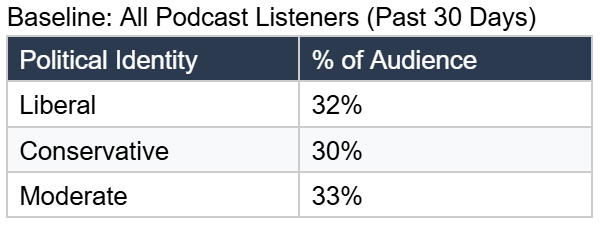
If that surprises you, it probably shouldn’t, given what we know about the growing breadth and diversity of the podcast audience. But it does tend to surprise people, because we’ve all been marinating in narratives about filter bubbles and partisan media silos for so long that it feels wrong for any media channel to be this evenly distributed. And yet, here we are.
Now, within that balanced baseline, individual genres do skew, and some of those skews are worth paying attention to.
TV & Film is the most liberal-leaning genre in podcasting by a wide margin, with a 19-point gap between its liberal and conservative audience shares (39% to 20%). Science is close behind at +16 points. On the other end, Business is the most conservative-leaning non-political genre, with conservatives outpacing liberals by about 7 points, followed by Health & Fitness at 6.
These are real gaps, and they track with broader cultural patterns that won’t shock anyone who has been paying attention to American life for the past decade.
The genre called Political Talk, the one you’d most expect to be a partisan monolith, is almost perfectly split: 34% liberal, 36% conservative, 29% moderate. For all the hand-wringing about echo chambers and the assumption that political podcast audiences are just people yelling into ideologically sorted voids, the actual data suggests something far more mundane: people across the political spectrum are interested in political content. They just happen to be listening to different political podcasts, which means the genre as a whole is a remarkably balanced tent, even if any given show within it is not.
News podcasts, similarly, are almost a photocopy of the overall podcast listener base: 32% liberal, 32% conservative, 34% moderate. If you were designing a genre from scratch to perfectly mirror the podcast audience, you couldn’t do much better than News.
The genre that caught my eye, though, was True Crime. It has the highest share of moderate listeners of any genre we looked at, at 37%, and it’s not particularly close. True Crime has always been something of an outlier in podcast audience research, whether we’re talking about its outsized appeal with women, its remarkably consistent performance in the top charts, or the sheer difficulty of producing a good one (you need narrative chops, editing chops, sound design chops, research chops, and, you know, an actual murder). Now we can add this to the list: True Crime is where the politically disengaged go to escape. It’s the genre equivalent of Switzerland, and honestly, that makes a certain kind of intuitive sense. When you’re listening to someone dissect a cold case from 1987, your feelings about marginal tax rates are probably not top of mind.
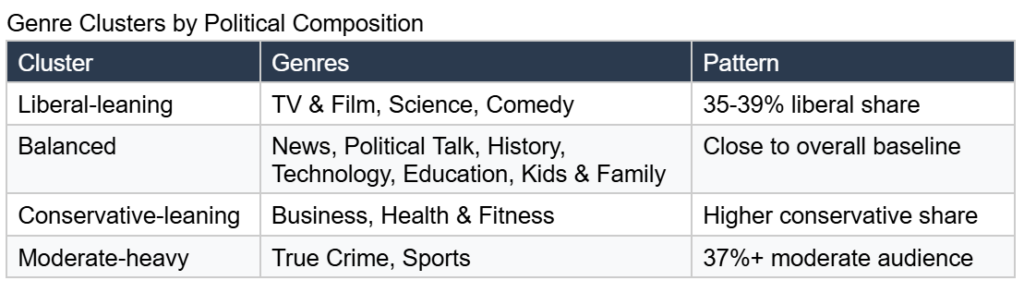
For advertisers and creators, there are some practical implications here. If you’re a brand that has been cautious about podcast advertising because of perceived political risk, the data suggests that most genres aren’t the partisan landmines you might fear. News and Political Talk, the two genres that sound the most politically charged, are among the most balanced audiences in podcasting. Your risk isn’t the genre. Your risk is the specific show, and that’s a targeting question, not a format question.
If you’re trying to reach a more conservative consumer, Business and Health & Fitness podcasts are worth a look, and these are genres where the content itself aligns naturally with products and services that skew toward that demographic anyway. If your brand identity is more culturally progressive, Science and TV & Film podcasts offer audiences where that identity feels like a natural fit rather than a forced one.
But the biggest takeaway, to me, is simpler than any tactical recommendation: the podcast audience, taken as a whole, is not the polarized caricature that broader media narratives would have you believe. It’s a third liberal, a third conservative, and a third moderate, with genre-level variation that mostly reflects pre-existing cultural affinities rather than anything podcasting itself has created. Podcasting didn’t make Science listeners liberal or Business listeners conservative. It just gave both groups something worth listening to.
And that, at the end of the day, is the job.
New Partners
Sounds Profitable exists thanks to the continued support of our amazing partners. Monthly consulting, free tickets to our quarterly events, partner-only webinars, and access to our 1,800+ person slack channel are all benefits of partnering Sounds Profitable.
Want to learn more about partnership? Hit reply or send us an email!