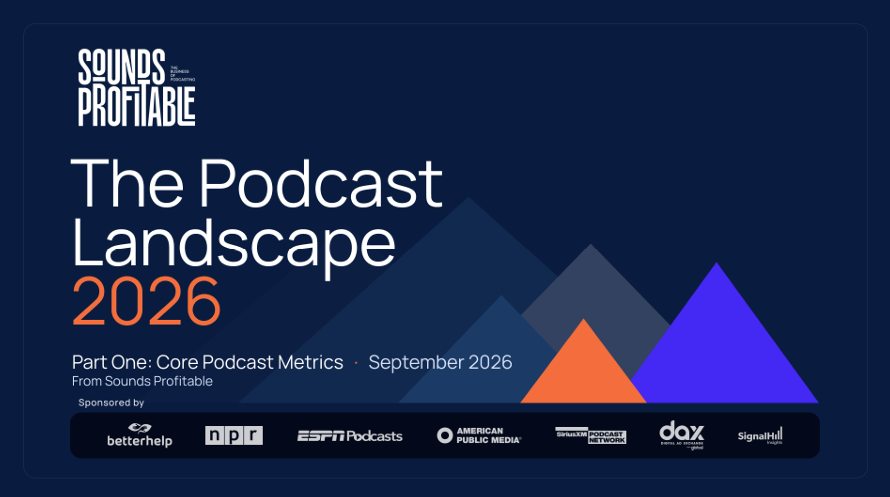
Expanding on his Podcast Movement NYC keynote, Sounds Profitable Partner Tom Webster highlights a key finding from The Podcast Landscape 2026. Respondents were asked about every place they’ve consumed a podcast in the past year. YouTube came first, followed by Spotify in a distant second. This year, Netflix jumped ahead of Apple Podcasts to come third. This raises some concerns, as for all the accusations of platforms like YouTube and Spotify being “walled gardens,” Netflix actually is a walled garden. Most shows can’t get on it, and if one does get in they’re getting into an ecosystem infamous for cancelling projects early if they don’t immediately turn a profit.
Webster stresses that Netflix isn’t doing anything to podcasting, and just 5% of podcast consumers call it their main platform, “so nobody’s listening is being rerouted yet.” Still, he worries its continued rise, built on shows far cheaper to make than scripted TV, turns podcasting, for much of America, “into Temu TV.”
“We are potentially making a deal with the devil when we put our programming on Netflix, because ultimately we don’t matter to Netflix, and I’d like us to focus on the places where we do.”
Most Podcast Listeners Aren’t Choosing Between Audio & Video. Why Is the Industry? by Sharon Taylor
Triton Digital Chief Revenue Officer Sharon Taylor argues the data does not support the recurring news cycle about podcasting leaving audio behind. According to the 2025 U.S. Podcast Report, only 7% of monthly U.S. podcast consumers watch podcasts exclusively. By comparison, 13% listen exclusively and 80% both. Video is reshaping how people discover shows far more than how they consume one once they’ve found it. Taylor’s prescription is to treat video as an expansion rather than a migration, building a two-lane show where a single video file generates both video and audio outputs and audio ads run inside video episodes instead of a separate video ad stack. She notes that podcasting’s first-year listeners skew more female and nearly a decade younger than long-tenured ones, and are far likelier to arrive through YouTube and social platforms.
Taylor calls the pattern “a classic example of format expansion, not format migration.” Rather than running video as a second production pipeline with its own files, metadata and ad workflows, she argues one video file can carry titles, descriptions and ad markers across both formats. Apple’s launch of HLS-powered video on Apple Podcasts, and Spotify for Creators and Megaphone’s decision in May to support it, show competitors converging on shared infrastructure, a sign that “one video asset needs to work everywhere the audience already is.” Citing Edison Research, she notes first-year consumers are 52% female versus 39% of long-tenured listeners, have a median age of 35 versus 43, and are nine times more likely to name Facebook, TikTok, or Instagram as their primary way of consuming podcasts. “Video is accelerating how people discover podcasts. But it is not replacing how most people consume podcasts once they’ve found something worth sticking with.”
Buyers Align on YouTube Measurement
At last week’s Sounds Profitable Business Summit, ADOPTER Media, Right Side Up and Oxford Road announced they will only count YouTube’s “Engaged Views” when buying advertising on the platform, with YMH Studios making a similar commitment.
Together, the three buyers represent roughly half a billion dollars in purchasing power. YouTube’s August 24 change counts a single frame, a cursor hovering over a thumbnail, or an autoplay a user scrolls past as a view, pushing public counts as high as 2.5 times engaged views, with just five business days’ notice. “We’re using Engaged Views. That’s our definition of a YouTube impression next year,” said ADOPTER Media CEO Glenn Rubenstein.
“Podcasting is having its viewability moment,” added Right Side Up’s Krystina Rubino, while Oxford Road’s Dan Granger said the industry should “get a little fed up” and make its voice heard. The full announcement is on YouTube.
Why Is It So Hard to Give You Money? by Annalise Nielsen
In a guest piece for Sounds Profitable, Lower Street Head of Podcast Strategy & Development Annalise Nielsen recounts trying to spend a $72,000 budget promoting a global consultancy’s podcast to Fortune 500 executives, and the five roadblocks she hit along the way. She describes shows with no clear ad contact, sellers who never answered repeated follow-ups, and minimum spends of $30,000 to $50,000, with several financial publications requiring $150,000 just to run a supplied 30-second spot. On one self-serve marketplace buy, a confirmed host-read became a producer-read post-roll at the same $54 CPM, and a national news podcast pointed her toward programmatic options that required a seat on a demand-side platform. Nielsen, who previously sold podcast ads, argues that without room for $10,000 to $50,000 tests, marketers can’t reasonably be expected to shift budgets into the channel.
“The AMP Accords were established because podcasting has a reputation amongst advertisers for poor or inaccurate measurement,” she writes. “But I had no idea there was an even bigger problem to overcome: letting advertisers spend their money on podcasts in the first place.”
Recaps from Podcast Movement
The Podglomerate’s Joni Deutsch recaps Podcast Movement’s New York City debut at Terminal 5, a Hell’s Kitchen concert venue, noting that Apple Podcasts, Spotify and YouTube had no booths at the event. World Podcast Network founder Bruce Chamoff argued that podcast SEO now means optimizing for both Google and AI tools, advising episode titles under seven words, “related episodes” sections in show notes, and attention to Reddit, the single most-cited site across AI and Google search results.
In his Podcast Landscape Study keynote, Sounds Profitable’s Tom Webster reported that 15% of adults have no social connection to podcasting and that smart TVs are the only device category gaining share with listeners. NPR Music’s Robin Hilton and Jacob Ganz closed the recap by saying podcasts are “more personality-driven than ever before,” while calling AI-generated content and music “the worst thing on the planet.”
Signal Hill Insights President Paul Riismandel recapped the Sounds Profitable Business Summit that preceded Podcast Movement, where 26 ten-minute sessions opened with Ira Glass on “Things that Podcasts Do Better.” Findings drawn from some 90,000 media consumers took up much of the stage. Signal Hill’s Matt Hird and Triton Digital’s Gabrielle Montana showed how Triton’s Demos+ draws on Signal Hill’s annual surveys of 12,000 listeners to profile individual podcasts well into the long tail, and Hird shared brand lift benchmarks based on 35,000 podcast consumers. Tom Webster’s 10 findings from 35 Sounds Profitable studies, covering 42,000 consumers over four years, included that podcasts have the lowest perceived ad load and that top advertisers get more brand lift from podcasts than from TV or radio.
On the ad side, Right Side Up’s Krystina Rubino and Acast CEO Greg Glenday agreed Spotify’s new skip button is “not the apocalypse,” with Rubino calling it “a symptom” and urging the industry, “don’t race to the bottom,” as happened with display. Former CNN anchor Don Lemon made the case for advertisers to back independent journalism podcasts despite brand safety worries, arguing, “everything is politics today… that is the zeitgeist.”
While they may not be top story material, the articles below from this week are definitely worth your time:
- Oxford Road is bringing Bumper’s new Bumper Score into its planning and buying, rating shows from 0 to 200 on their ability to deliver ads to verified listeners across audio and YouTube.
- YouTube CEO Neal Mohan detailed the next wave of YouTube features at Made on YouTube, including custom homepage feeds built from prompts like “Witty podcasts for my daily 30-minute commute,” new podcast discovery tools in YouTube Music, and A/B testing of up to three video cuts in YouTube Studio.
- Apple Podcasts and Apple Maps launched Hidden Histories guides for Chicago, Los Angeles, New York City, San Francisco and Washington, D.C., plotting podcast episodes onto real-world locations, as Apple also confirmed video is coming to Apple Podcasts Subscriptions in more than 170 countries and regions.
- Triton Digital’s August 2026 Canada Podcast Ranker has CBC’s Front Burner holding the top spot ahead of World Report and The World This Hour, while The Mile Zero Murders from Uncover jumped seven places to No. 8.