This year Sounds Profitable is sponsoring the Little Black Book Beach at Cannes Lions. For all those attending, we have a free custom graphic generator live to help folks announce where they'll be hanging out June 22-26. Just upload a headshot, plug in your details, and you'll get a socials-ready graphic in seconds. Also: Sounds Profitable partner companies will receive up to three tickets to access the LBB Beach all week, get in touch for more details!
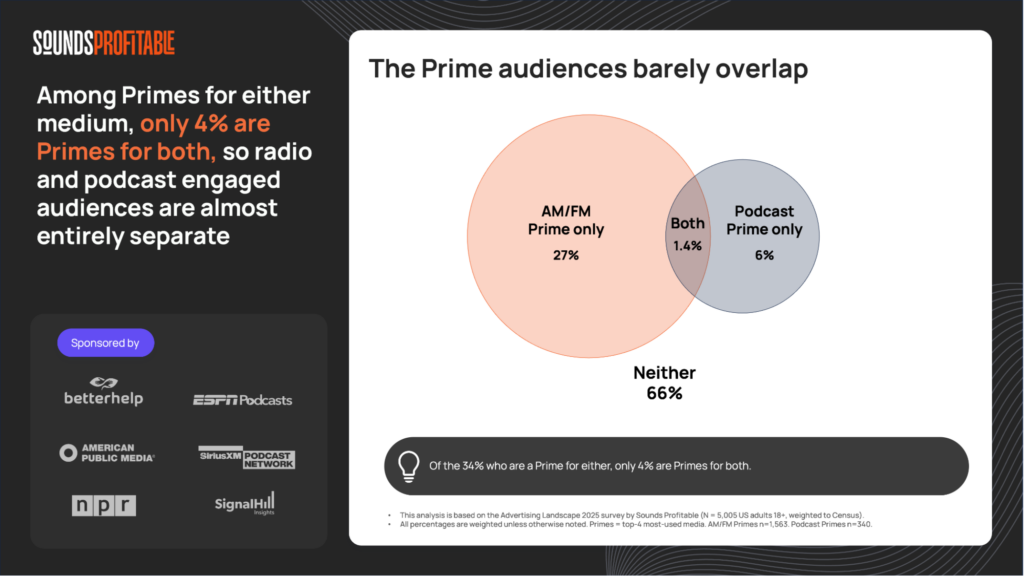
The only thing I love more than an analogy is a TORTURED ANALOGY, and boy are you gonna get one today. I was in Toronto a few weeks ago, presenting at Radiodays North America. One of the slides I walked the room through was a Venn diagram from our 2025 Advertising Landscape study, comparing AM/FM radio Primes with podcast Primes.
A Prime, in the framework we use at Sounds Profitable, is someone who uses a given media channel every day and considers it one of their top four or five choices among ad-supported media on a typical day. Not just a monthly user. Not even just a daily user. A daily user who also ranks that channel among the media they value most. It’s a high bar, and it’s apples-to-apples across every channel we measure — audio, video, streaming, social — evaluated the same way.
The question the diagram was answering: how much do AM/FM Primes and podcast Primes overlap? Here it is, just as they saw it (and keep in mind that these percentages pertain to ad-supported radio and podcasts only):
.
Now, this is with the Primes, as stated, but even with monthly users of each (the broadest screen I’d consider), they overlap less than you’d think. In the same study, a nationally representative sample of 5,005 U.S. adults, 76% of Americans used AM/FM radio, ad-supported podcasts, or both in the past month. The overlap between the two was 21%. Forty-five percent of U.S. adults used only AM/FM. Ten percent used only ad-supported podcasts. For two media that share the word “audio” and often share the same device, those numbers already point to different audiences.
Monthly reach is the loose sieve, though. Anyone who caught a podcast once or had the radio on in a waiting room shows up in that data. When you tighten the filter to Primes, the picture changes.
AM/FM Primes are 27% of U.S. adults. Podcast Primes are 6%. The overlap is 1.4%. Of the 34% of U.S. adults who are a Prime for at least one of these media, only 4% are Primes for both. The people who are most engaged with radio and the people who are most engaged with podcasting are, with very few exceptions, different people.
The easy interpretation is that radio and podcasting are in direct competition. That one is eating the other’s lunch. That the zero-sum framing the industry has carried for a decade is the right one. The Prime data says something else. Two media with almost no overlap among their most engaged listeners aren’t competing. They’re not even in the same conversation at the level that matters most to advertisers.
Radio has spent the better part of fifteen years shedding its 18–34 audience. This isn’t a content failure. It’s the predictable consequence of consolidation-era decisions: format standardization, cost reduction, safe-playlist programming calibrated to hold the audiences radio already had. Anyone who watches radio ratings knows this. The result is that radio’s most engaged listeners skew older, and radio’s most compelling advertising story increasingly lives in the 55+ market. I also live in this market, so it’s not a bad place to live, but we still have some work to do with agencies and brands on that score.
Podcasting has the mirror problem. The medium over-indexes on younger, educated, urban consumers. It has, thus far, underperformed with the 55+ demographic, a cohort that is growing as a share of the U.S. population and represents an increasingly wealthy consumer segment. Podcast publishers have been circling this market for years without fully cracking it.
Neither medium can metabolize the full available audience on its own.
This is where my tortured analogy comes in, thanks to the spinning cork ball covered in sticky notes that is my brain. The first thing I thought of in trying to describe the relationship between radio and podcasting was the Portuguese Man o’ War. Despite appearances, it isn’t a jellyfish at all. It’s a colony of seven specialized types of organism — floaters, hunters, digesters, reproductive units — genetically identical but morphologically different, none of them capable of surviving on its own. I’d like to thank Mrs Dyer from 10th grade biology for this episode of The More You Know.
The Man o’ War is also, despite having no propulsion of its own and no central nervous system, one of the more formidable creatures in the open ocean. Its tentacles average thirty feet and can stretch to a hundred. It accounts for roughly ten thousand stings a year in Australian waters alone. Almost nothing eats it: a few specialist sea slugs, sea turtles too thick-skinned to feel the sting, the occasional sunfish. Contrary to decades of beach lore and one very confident Friends episode, peeing on the sting makes it worse, not better. And — relevant for two media that traffic heavily in talk — it manufactures its own gas! The float on top isn’t passive buoyancy. The animal actively produces the carbon monoxide that keeps it on the surface.
Radio and podcasting are something like this. A seller offering both inventory types isn’t presenting the same audience twice at a slight discount. They’re presenting two almost entirely non-overlapping engaged audiences in a single buy. The frequency duplication at the Prime level is essentially zero. From a campaign planning standpoint, that’s not a bundle. That’s a different kind of reach altogether. It’s a beast with wide-ranging tentacles.
For advertisers who’ve been treating “audio” as a single category, this changes how cross-channel campaigns should be planned, measured, and frequency-capped. For the companies that hold both types of inventory, the combined asset is worth more than either piece alone, and the Prime data is the evidence for that claim.
The symbiosis framing isn’t a rescue narrative for radio. Radio faces real structural pressures that have nothing to do with podcasting: declining ad revenue, a younger audience it hasn’t recovered, an ownership landscape still working through decisions made in 2008. The fact that radio and podcasting serve almost entirely different engaged audiences doesn’t mean radio is healthy. It means the combined asset, in the hands of the right seller, is more valuable than the competitive frame has let anyone see clearly.
The Man o’ War looks like a jellyfish. It isn’t. A jellyfish is the limp thing that washes up at the Jersey shore, the one kids poke at with a stick. The Man o’ War is a tank. It’s a beast. And if it stings you, you can’t just pee on it.
For sellers and buyers with both radio and podcasting in their inventory, the practical implication is real: there’s little waste in increasing spend across both. The combined engaged audience is bigger and less duplicated than the competitive frame suggests.
The two channels together are a formidable beast indeed.
New Partners
Sounds Profitable exists thanks to the continued support of our amazing partners. Monthly consulting, free tickets to our quarterly events, partner-only webinars, and access to our 1,800+ person slack channel are all benefits of partnering Sounds Profitable.
- beehiiv is the platform for anyone with an audience to publish, grow, and monetize — across newsletters, websites, and podcasts.
- Podigee is an all-in-one video and audio podcast hosting and distribution platform that turns one hour of recording into a month of content.
Want to learn more about partnership? Hit reply or send us an email!