by Mattia Verzella, Vice President of Programmatic Partnerships at Triton Digital.
“Stop Comparing CPMs — Each Revenue Channel Plays a Different Role.”
When publishers look at ad revenue in podcasting and streaming audio, the first instinct is often to compare CPMs across channels and platforms. On paper, this feels intuitive: if one buyer pays $18 and another $8 for a thousand impressions, the former must be more valuable. But this is a flawed way to evaluate revenue sources. Not all demand is created equal, and the quality, stability, and long-term strategic value of each dollar varies dramatically across programmatic, direct sales, and backfill opportunities.
The problem is that most publishers evaluate it all the same way: by CPM. That single metric flattens what is actually a layered, strategic system — and it drives decisions that quietly erode long-term revenue. The fix isn’t a new platform or a better rate card. It’s a smarter framework for understanding what each dollar is actually worth.
Programmatic vs. Direct Sales
Programmatic demand represents volume, liquidity, and automation. It ensures fill when direct campaigns are not running, but it comes at the price of volatility. CPMs fluctuate based on targeting parameters, seasonality and real-time auction dynamics. Most importantly, programmatic spend is often opportunistic—a buyer is not committing to your content or brand; they are committing to an audience segment at the right price, at the right moment.
Direct sales, in contrast, come with guaranteed inventory, committed delivery, and a closer relationship between buyer and seller. Whether sold as host-read sponsorships, dynamically inserted campaigns, or long-term brand partnerships, they reflect an advertiser’s conviction in the value of your environment, context, and halo effect.
Exclusivity, Prioritization, and Backfill
Direct sales are IO-based, which means committed spend and guaranteed delivery. This naturally justifies priority access to inventory, often with exclusivity clauses prohibiting or restricting programmatic from competing for the same slots. A campaign that reflects a strategic partnership justifies this prioritization because it deepens buyer loyalty and strengthens publisher positioning.
Backfill, on the other hand, should never set the benchmark for value. It is a necessary yield-management tool—catching what would otherwise go unsold—but it serves a fundamentally different purpose than negotiated sales.
This is why publishers should avoid the trap of comparing “apples to oranges” when looking at CPMs. A direct $18 CPM deal with white-glove treatment and multi-quarter spend is not equivalent to an $8 open-exchange CPM, which may vanish next quarter. The yield figure alone cannot capture the durability and strategic implications of the revenue source.
The Hotel Analogy: A Blueprint for Smarter Inventory Pricing

Think about how a hotel fills its rooms. A corporate contract, a preferred listing on a travel booking platform, a last-minute discount, a “distressed” rate to avoid an empty night—each channel serves a different purpose and commands a different price.
Audio publishers manage inventory the same way, and the same logic applies: not all revenue is equal, and the channel that closes the deal shapes the value of the deal itself.
Demand channels overlap with the ones in advertising:
- (Direct Sales) Corporate contracts and direct bookings represent the hotel’s owned demand channels, or direct sales. They are negotiated in advance, priced for stability, and built on long-term relationships.
- (Programmatic private marketplaces / curated deals) Preferred placements on Online Travel Agencies (OTAs) resemble curated programmatic demand. Pricing remains responsive to market conditions, while access and quality are governed by platform rules and commercial agreements.
- (Open programmatic) Last-minute OTA bookings parallel open programmatic. Pricing adjusts dynamically based on remaining inventory and real-time demand.
- (Remnant / backfill) Distressed occupancy mirrors backfill inventory. The primary goal is utilization of otherwise unsold capacity.
From the seller’s perspective, the physical asset remains identical in every case. What changes is the buyer type, timing, and level of commitment. No hotel executive interprets last-minute pricing as a signal that the asset has lost value. It reflects timing and demand structure, not quality.
To buyers, these channels carry vastly different value perceptions. Comparing their price points is misleading because each channel plays a different role in the commercial ecosystem.
Revenue Implication for Publishers
Audio publishers must internalize this strategic approach that can be counterintuitive: not all dollars are equal, nor do they carry the same strategic weight.
The value of a revenue source is not defined only by CPM, but by the type of buyer relationship it creates, the consistency of demand behind it, and the positioning it reinforces over time.
- Direct sales establish premium positioning and strengthen advertiser relationships.
- Open Programmatic and Private Marketplace demand provide scalable monetization and adapt to changing market conditions.
- Backfill ensures inventory is fully utilized.
A balanced revenue strategy is not built on maximizing one channel, but on aligning each demand source with its structural role in the marketplace.
The same way a hotel brand would never move all its available accommodation to so-called “last-minute” vacation packages just because a few rooms sold quickly, publishers should avoid fixating on programmatic CPM volatility. The end goal is a healthy mix where each revenue source is judged by its strategic role, not its surface-level rate.
A Critical Constraint: The Perishability of Inventory
Let me introduce a very important constraint to the revenue strategy above: the time sensitivity inherent to real-time auctions. In other words, the inventory that you do not want to sell at a different price point TODAY cannot be decided to sell at a different CPM TOMORROW. This is because at the exact moment an opportunity passes, that inventory no longer exists, and when a new opportunity comes, the buyer might not even be there because the campaign is already complete.
Programmatic advertising allows real-time optimization of inventory sales, ensuring that every impression is valued at its highest potential. This means the publisher does not have to worry about underselling today to chase future opportunities at lower prices, but can rely on dynamic and intelligent management that maximizes the value of each impression when the market is ready to buy it.
The “Triangle of Sadness” (for Revenue)
In Swedish, the triangle of sadness refers to the physical wrinkles that form in the area between the eyebrows and above the nose when people are worried, tense or concentrated.
The graph below uses anonymized, real-world programmatic revenue data to illustrate what happens when a publisher makes the wrong floor-pricing call. Time runs along the X axis; revenue along the Y.
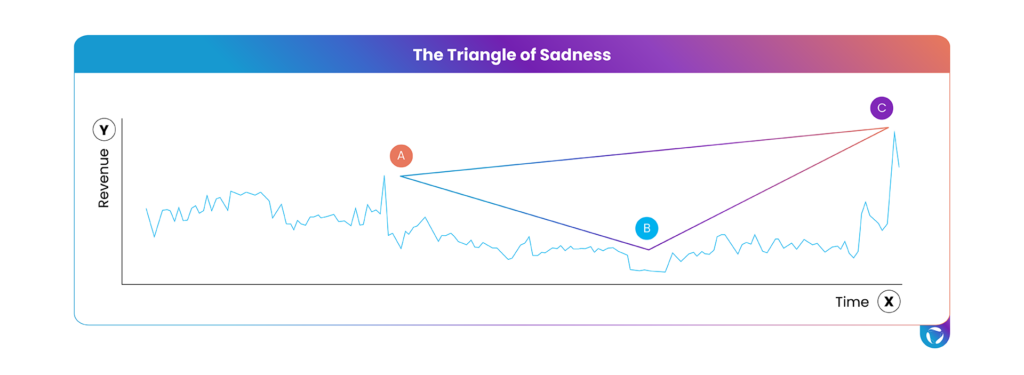
Three points on the chart tell the full story:
- A marks the day when the publisher decided to set a higher floor CPM price than it was set up until that day.
- Between A and B represents the dramatic decline of revenue as a direct effect of the publisher’s choice.
- Between B and C is the rise in revenue when the publisher decided to set a lower floor price than it had been set up until that moment.
In other words, raising the floor price made the revenue tank.
Revenue Optimization and Bid Landscaping
Revenue is a function of both price and volume. CPM alone provides an incomplete view of outcomes.
Wise publishers monitor and adjust floors to balance yield, revenue, and fill.
The most important paradigm shift for publishers is moving from CPM comparison to revenue optimization—and bid landscaping is the set of tools and analysis to achieve that.
- A higher floor price can increase CPM while reducing demand and lowering fill rates.
- A lower floor price can reduce CPM while improving clearing efficiency and increasing total revenue.
The objective is not price maximization, but total revenue optimization across all demand sources. Bid landscaping operationalizes this principle.
To optimize revenue, publishers should treat floor pricing as a dynamic control system, not a static rule. A single global floor ignores how demand behaves across segments. Inventory performs differently by geo, device, time of day/week/month/quarter and audience quality.
Bid landscaping in programmatic is where your pricing strategy becomes operational. Publishers should treat bid landscaping as an active discipline:
- Segment the inventory.
- Set initial floors based on historical performance.
- Monitor key metrics daily.
- Adjust quickly, with controlled variation in pricing, as signals change.
Effective monetization relies on continuous floor optimization. Publishers monitor how pricing impacts fill rate, cleared CPM, and total revenue together, then adjust incrementally based on observed demand behavior.
Hospitality revenue managers have applied this approach for decades through dynamic pricing based on seasonality, occupancy, and booking windows. Audio publishers operate under the same constraint of perishable inventory with fluctuating demand.
Key Takeaway
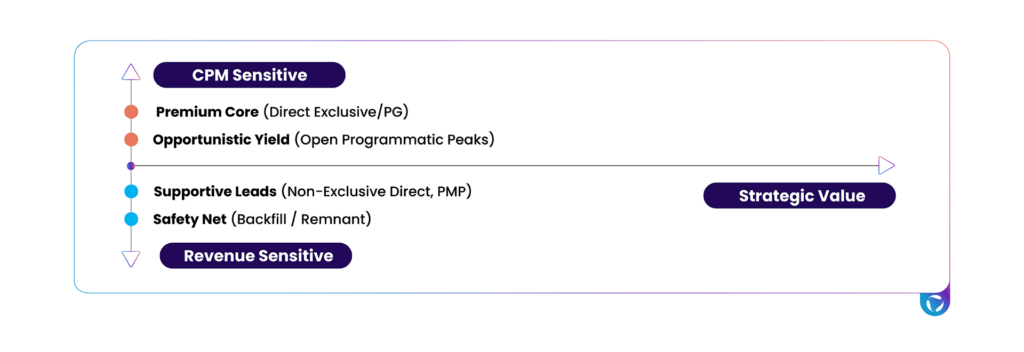
Just as retailers price flagship products differently from outlet or liquidation inventory, publishers should avoid comparing CPMs across direct and guaranteed deals, programmatic PMPs, open marketplace, and backfill.
Each demand channel serves a distinct role in long-term monetization, inventory management, and brand positioning.
When managed strategically and operationally, this layered approach allows publishers to turn inventory into a scalable revenue stream through programmatic and, with disciplined execution, into a controlled and predictable growth driver.