By Ben Robins
Last time, we looked at why UK 18-34s trust podcast advertising more than any social platform. Trust is interesting. But trust that doesn’t lead anywhere is just a nice statistic. So what happens after the trust?
The Headline Number
44% of UK 18-34 podcast listeners made a purchase after hearing a podcast ad. That’s against 29% across all ages, and just 17% among the 55+ audience. The age gap here is enormous — more than double from oldest to youngest.
Go one level deeper, though, and the number changes shape. Among UK 18-34 listeners, the average number of ad-attributed purchases made via podcasts is 1.13. Not whether they bought something — how many times, over the past three months. That’s a different question, and it matters. A platform that converts someone once is interesting. One that gets the same person to buy again and again is doing something structural.
Where Podcasting Sits Next To Everything Else
Stack podcasting’s 1.13 against the other platforms we measured and the picture varies a lot by platform.
TikTok leads the field with a purchase mean of 1.52. On the face of it, that’s impressive, but it highlights a different kind of purchase trigger and it skews massively to the young: 1.71 among 18-34, dropping to 0.84 among 55+. TikTok’s headline figure is, in practice, an 18-34 story sitting on a comparatively small base. Strip out the youngest cohort and the platform’s purchase power looks very different.
Instagram tells the same story — strong among the young (1.41), collapsing with age (0.33 among 55+): platforms that convert hard among the people who grew up on them, and barely register with anyone older.
And then there’s Facebook, which is different altogether.
Facebook shows 1.12 among 18-34, 1.07 among 35-54, and 1.11 among 55+ — virtually flat.
Facebook is the only platform we measured where purchase behaviour doesn’t care how old you are.
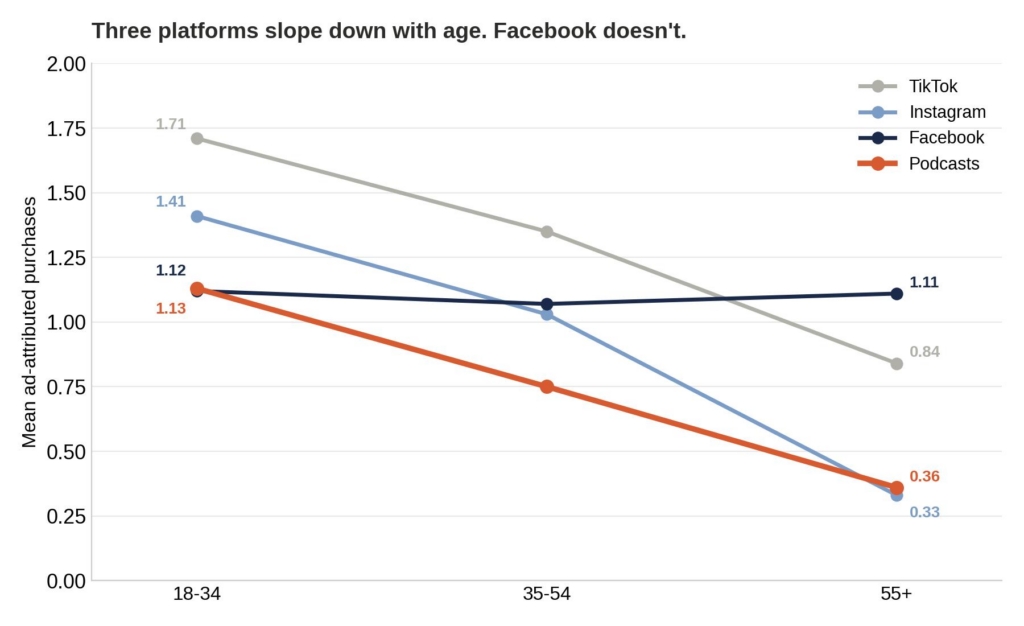 We’re focused here on younger audiences, but it’s worth being honest that podcasting still struggles to break through with the over-55s. The purchase mean for podcasts among 55+ is 0.36 — on par with Instagram (0.33), below TikTok (0.84), and well below Facebook (1.11). Podcasting does not win on purchase behaviour at every age.
And that matters: the UK’s 55+ audience holds a disproportionate share of discretionary wealth, and right now podcasting isn’t capturing much of it. Whether that’s a content gap, a format gap, or simply an audience that hasn’t been won over yet is a question worth asking — and for advertisers and creators willing to ask it, a gap this size in a wealthy demographic looks less like a weakness and more like unclaimed ground.
Why Facebook is the real story in this data
Every other platform we measured splits cleanly by age. Younger users convert at multiples of older users. That’s the expected pattern — it’s the same generational divide we saw in Post 3 on trust, and the same one Post 1 found in reach.
Facebook doesn’t follow it, and the reason isn’t complicated. Facebook isn’t a young platform discovering an old audience, or an old platform clinging to relevance. It’s a mature platform where everyone, regardless of age, has had a decade or more to settle into the same habits. The purchase behaviour isn’t generational. It’s just… settled. Whoever’s there, buys at roughly the same rate, because the relationship between the platform and the purchase decision has had years to calcify into habit.
That’s a ceiling for Facebook, not a strength — its conversion power isn’t growing, it’s plateaued.
What Podcasting Is Doing Instead
Podcasting’s 1.13 among 18-34 runs on something TikTok’s 1.71 and Facebook’s flat 1.1 don’t have: trust that’s been earned, not assumed.
Recall this finding from Post 3 — UK 18-34 podcast listeners trust podcast advertising at rates roughly 10 points higher than the all-ages average, and higher than every social platform measured. That’s what moves trust past “interesting” — here, it’s the mechanism that drives the next action: the purchase.
A TikTok purchase can be impulsive. When the algorithm puts something in front of you, the moment feels urgent so you buy.
A podcast purchase runs through a different channel entirely: a host you’ve chosen to listen to, recommending something they say they use, in a relationship that’s had months or years to build. It’s slower — and stickier. The purchase isn’t the result of a single well-targeted moment. It’s the result of accumulated credibility cashing out.
What happens before the purchase
Purchase is the end of the road, but it’s not the only stop. Across UK podcast listeners, 87% take some action after hearing a podcast ad. 30% search for more information. 20% discuss it with someone else. 17% visit the advertiser’s social channels. 14% write down a promo code. 6% buy immediately.
That’s not a single conversion event. It’s a funnel with real stages, and most of the volume sits upstream of the purchase itself — in research, in conversation, in consideration. For advertisers who are used to thinking about podcast ads as a recall play, this is the part of the story that gets missed: the intent doesn’t evaporate when the ad ends. It moves somewhere else first.
What this means for advertisers
Different platforms convert through different mechanisms, and treating them as interchangeable inventory misses what’s actually happening underneath the numbers.
TikTok and Instagram convert through immediacy among an audience that’s young enough to have grown up inside them. Facebook converts through sheer habitual ubiquity, regardless of age. Podcasting converts through something slower and harder to manufacture: a trusted voice, recommending something, to someone who chose to listen.
If your goal is a single impulsive purchase from an 18-34 audience, TikTok’s numbers make a real case for themselves. If your goal is a purchase that’s part of a pattern — someone who buys, and is likely to buy again, because the recommendation came from somewhere they trust — the podcast numbers tell a different and arguably more compelling and durable story.
The UK podcast audience listens, trusts, and acts on what it hears — repeatedly.
Next time: the strategic synthesis. Effective reach, platform allocation, and what UK advertisers should actually do with all of this.
This is the fourth of five posts unpacking the study. If you want the full picture — all five posts as they’re published, the press coverage so far, and the original Podcast Show presentation — I’ve put everything in one place: the UK Advertising Landscape Study page on the Sound Insights site.
The 2026 UK Advertising Landscape Study was conducted by Sounds Profitable in partnership with Sound Insights. Fieldwork ran February 2026 with n=5,033 UK adults aged 18+, weighted to census.