Last week at Podcast Movement in New York, I gave a keynote built around a phrase we all say without thinking: “wherever you get your podcasts.”
I gave a keynote built around that same phrase five years ago, at Podcast Movement in Nashville, when we had new research showing that YouTube was increasingly where people were consuming podcasts. That went over about how you’d expect. Some of the room thought it was flat-out wrong, because they didn’t see it in their downloads. Some thought I was crazy, which is demonstrably true but not germane to the discussion. And some believed it and rebuilt their businesses around it; a few of our partners still point to that afternoon as the moment they did. The point I was making in 2021 was that if you’re going to say “wherever you get your podcasts,” you had better actually be there, and a lot of shows weren’t. I still don’t think every podcast has to be on YouTube, or has to be video at all, but you are working with one hand tied behind your back if you don’t have some kind of YouTube strategy, even if the content itself never goes there.
I think 2026 is another one of those moments, and it comes from a question we’ve asked in all four years of The Podcast Landscape, our flagship study of podcast consumption in America. The question is simple: where are all the places you’ve consumed a podcast in the last 12 months? You can check as many as you like. It has nothing to do with downloads, or how much you consume, or which one you use most. It’s just the surfaces where you encounter podcasts.
The top two are what they have been for several years now. YouTube is first, by a lot. Spotify is a distant second. Number three is not Apple Podcasts. It’s Netflix.
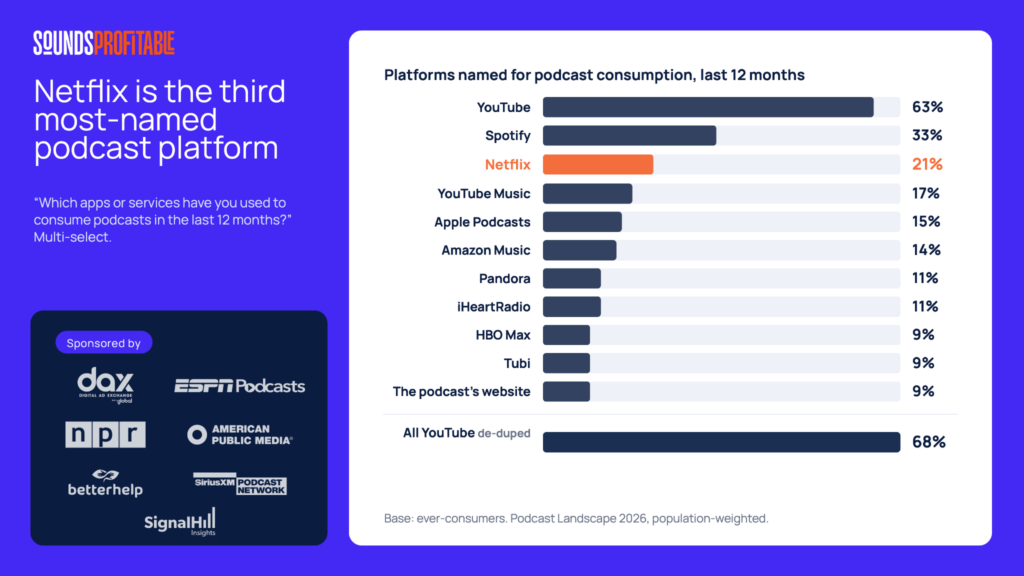 Some of you will struggle with that, the way some of you struggled with YouTube in Nashville, so remember that this question is a low bar. It only asks whether you’ve consumed a podcast there at some point in the past year. Netflix is enormous; while they have stopped reporting this, the last figure they released was 89.63 million paid memberships for the US and Canada combined, at the end of 2024. And the podcasts on it are hits, make no mistake. Netflix is showcasing some of the best of what we make, not peddling junk, so a fifth of podcast consumers encountering one there is entirely plausible. It’s the fact that it’s third that should give us pause.
I was not troubled when the YouTube numbers first dropped, and I have never been troubled by them since, because YouTube has been a tremendous boon to this industry. YouTube gives you all the opportunity you could possibly want. Earlier this month, the media analyst Evan Shapiro, with Shira Lazar and Whalar, published a list called the Affinity 100: the hundred creators with the most impact right now, ranked on what audiences actually do with their work rather than on follower counts. Almost none of them were celebrities before they were creators, and you may not recognize most of the names, because you aren’t in the pockets of audiences where these people are enormously influential. Those pockets are not small, and it was YouTube and TikTok that let people who were never movie stars make their fortunes. YouTube has changed some of the economics of podcasting, but in exchange it gave us free hosting and the best discovery engine we have; it remains the top source of podcast discovery in the Landscape. So YouTube does not trouble me.
Netflix troubles me. I said as much to the room at Podcast Movement, and I’m going to say it to you now, for three reasons.
The first is that your podcast is not on Netflix, and it can’t be. We like to call Spotify and YouTube walled gardens, but they aren’t, really. You can put your show on YouTube or on Spotify, promote it there, and as long as you don’t violate the terms of service, you stay there. You cannot put your show on Netflix. The podcasts that are on Netflix are, frankly, the shows that don’t need the help; they were already the upper echelon by audience, which is precisely why Netflix picked them. If you are in podcasting’s sizable middle class, not large enough to be at the very top but large enough to make a living, you can’t possibly get on Netflix. That makes it the great gatekeeper of this business, and as I recall from when I got involved in podcasting back in 2005, one of the whole points of the thing was that there were no gatekeepers. I’m not sure why we are feeding our content to one of the biggest gatekeepers in media.
The second reason is Mindhunter. A lot of people watched it, and a lot of people were furious when it did not get a third season, canceled for reasons that never satisfied anyone who loved it. Netflix will cancel things based on whether you finished the episodes, or on the velocity of viewing, or on whether the season got watched inside a given window, and none of that is a judgment about the show. I was more distressed when they canceled The OA, which was radically original, well acted, and ended after two seasons on an infuriating cliffhanger. This rolls back up to the gatekeeper problem. If you can’t get your content on there, that’s one thing, but if you can get it on there and it can simply be canceled, and I don’t mean terms-of-service canceled, I mean not-popular-enough canceled, then Netflix is being the ultimate gatekeeper in a way that runs against everything this medium stands for.
The third reason concerns me the most. Look at the top three platforms where people say they ever consume podcasts, and remember that this is about where they encounter podcasts, not how much they consume. None of the three is an app or service that showcases podcasts. When you log into YouTube, you can get to podcasts, but they are not what you are presented with, and the data supports that. When we ask people how they discovered a podcast on YouTube, the top answer is that they searched for a specific show or topic, followed by searching for a specific host or celebrity, and together those roll up to 77% of YouTube discoverers attributing the discovery to intentional search.
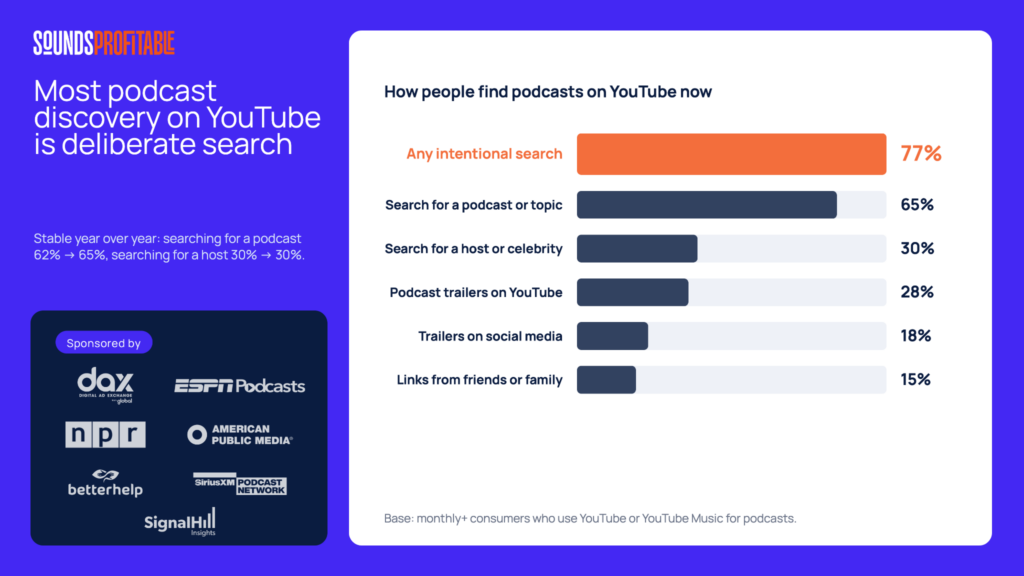 That’s not serendipity, and it’s not algorithmic discovery. I’m not knocking YouTube here. It contains podcasts, but it was not built for them. The same is true of Spotify, which I also think has been a boon to this industry because it keeps audio fresh, but it is primarily a music app, and podcasts are not what it puts in the window. And I don’t even need to make the point about Netflix. When you log into Netflix, what you see are the originals Netflix has shelled out for, not your show, ever, and not even the top podcasts. The three biggest sources for encountering podcasts in the United States are not places that showcase podcasts.
The great danger in this is that we are losing our Tower Records. I don’t mean Tower as a place that kept physical media alive. I mean it as a place that existed solely to showcase the culture, that existed solely to showcase what we do. When we lost Tower, physical music lost a lot, and the charts you see now on a service like Spotify have a different character. They are overweighted with the very top artists and dramatically underweighted with the middle class: the number 30 album, the artists who used to live in the top 40 with one hit or a few. Music sales now look like the music section at Walmart, a place that does not focus on music, where the physical music department is either a single display for Taylor Swift or a rack of maybe 30 to 50 CDs that don’t make sense as a top 40 of anything, just classics and hits from the past plus whoever is biggest right now. There is no back catalog and nothing that says music matters here. It’s one kiosk away from the iPhone cases.
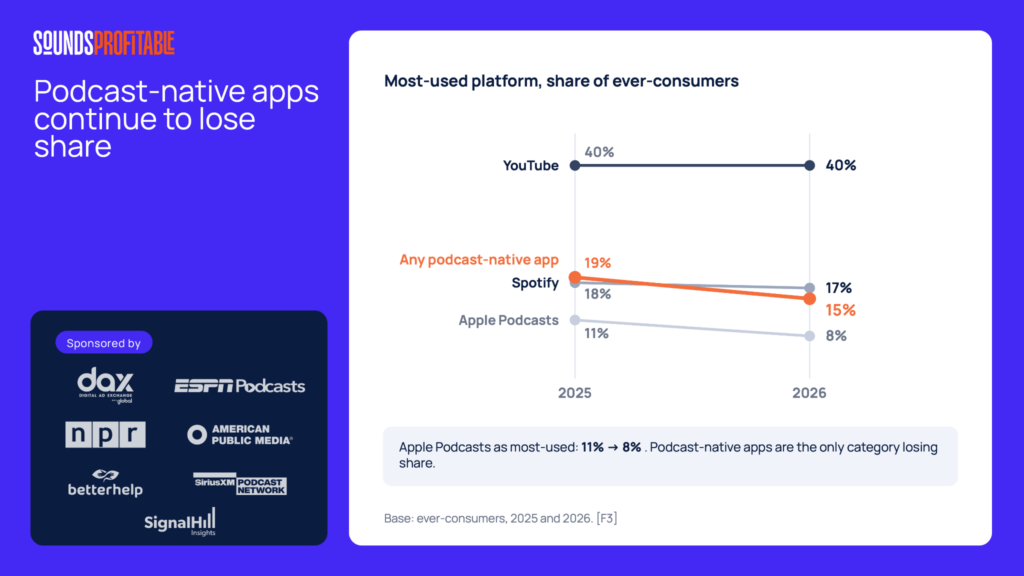
When we don’t have outlets that showcase what we do, what we do becomes less visible, and the Landscape has a number for that too. Last year, 19% of podcast consumers named a podcast-specific app, everything from Apple Podcasts to Pocket Casts to Overcast, as the app they use most to consume podcasts. This year that 19% is 15%. To me that is every bit as concerning as Netflix in third place. When we lose our showcase, the place where we get to sing the song of podcasting, it isn’t only the long tail that suffers. It’s anybody outside the top 500 or 1,000 shows. No more serendipity.
 If the places where podcasts are encountered surface them only through deliberate search, or through a handpicked selection that a gatekeeper has judged relevant to its other programming, then we risk podcasting, as a medium, declining the way physical media has. That will show up in smaller and mid-tier shows first, but also in whole genres, because YouTube and Netflix are not built around audio and are not going to recommend you an audio podcast. The genres that are most audio-forward, and often too expensive to produce as video, are scripted shows, documentaries, drama, audio fiction. Entire genres could get forgotten because they don’t fit what Netflix is looking for in a podcast.
And what is Netflix looking for in a podcast? Think about what one looks like there. It’s Pete Davidson talking to somebody across a couple of mics, and that is a hell of a lot cheaper to make than the third season of The OA I would rather have. It’s cheap programming, cheaper to produce and cheaper to buy than another season of a show sitting on the algorithmic edge of “worth it.” I worry that the continued rise of Netflix in podcasting turns podcasting, for much of America, into Temu TV.
I want to be careful here, because there is a version of this argument that is just an old man yelling at a streaming service (I also live in this market). Netflix is not doing anything to us. It is a customer, and for the shows that get the call, a lucrative one. Twenty-one percent of podcast consumers touched a podcast there in the past year and 5% call it their main platform, so nobody’s listening is being rerouted yet. And the audience never cared about our gatekeepers. The promise of no gatekeepers was a promise we made to creators; listeners only ever signed up for good shows wherever they happened to be, and a fifth of them found one on Netflix and presumably had a nice time. So the answer is not to boycott Netflix, and nobody asked me anyway. The answer is to make sure the places that do showcase podcasts don’t quietly disappear while the biggest shows chase the biggest check, because those places are where the next Affinity 100 gets found.
Which is why this is the first step and not the last. We are the trade association for this industry, with nearly 250 partners at this point, and we are going to have conversations with all of them about this, because I think the industry needs to be careful about deals that are lucrative in the moment and, for the medium, might be shooting ourselves in the foot. I don’t want to be Temu TV. I want every genre and topic in podcasting to keep having equal access to an audience, and not to be subject to the whim of a gatekeeper. We are potentially making a deal with the devil when we put our programming on Netflix, because ultimately we don’t matter to Netflix, and I’d like us to focus on the places where we do.
“Wherever you get your podcasts” now includes a place no one can get your podcast. Tu-dum.
Thank you to the wonderful sponsors of The Podcast Landscape 2026: American Public Media, BetterHelp, NPR, ESPN Podcasts, SiriusXM, and DAX, as well as our research partners at Signal Hill Insights. The Podcast Landscape 2026 comprises a sample of 5,473 US adults, 18 years of age and older, weighted to the US Census to represent the US population.
New Partners
Sounds Profitable exists thanks to the continued support of our amazing partners. Monthly consulting, free tickets to our quarterly events, partner-only webinars, and access to our 1,800+ person slack channel are all benefits of partnering Sounds Profitable.
-
RadioActive Media: A hands-on full service audio influencer marketing firm who practices what they preach.
-
Swerve TV is an operator of Free Ad-supported Streaming Television (FAST) channels and supplier of sports and podcast content to the Connected TV (CTV) ecosystem.
-
City Cast is a network of daily local podcasts, newsletters, and social media channels that make you feel more connected to the city you love.
-
Kinetic Content produces top-rated series across multiple platforms, including the global hits Love Is Blind, The Ultimatum, and Perfect Match..
Want to learn more about partnership? Hit reply or send us an email!