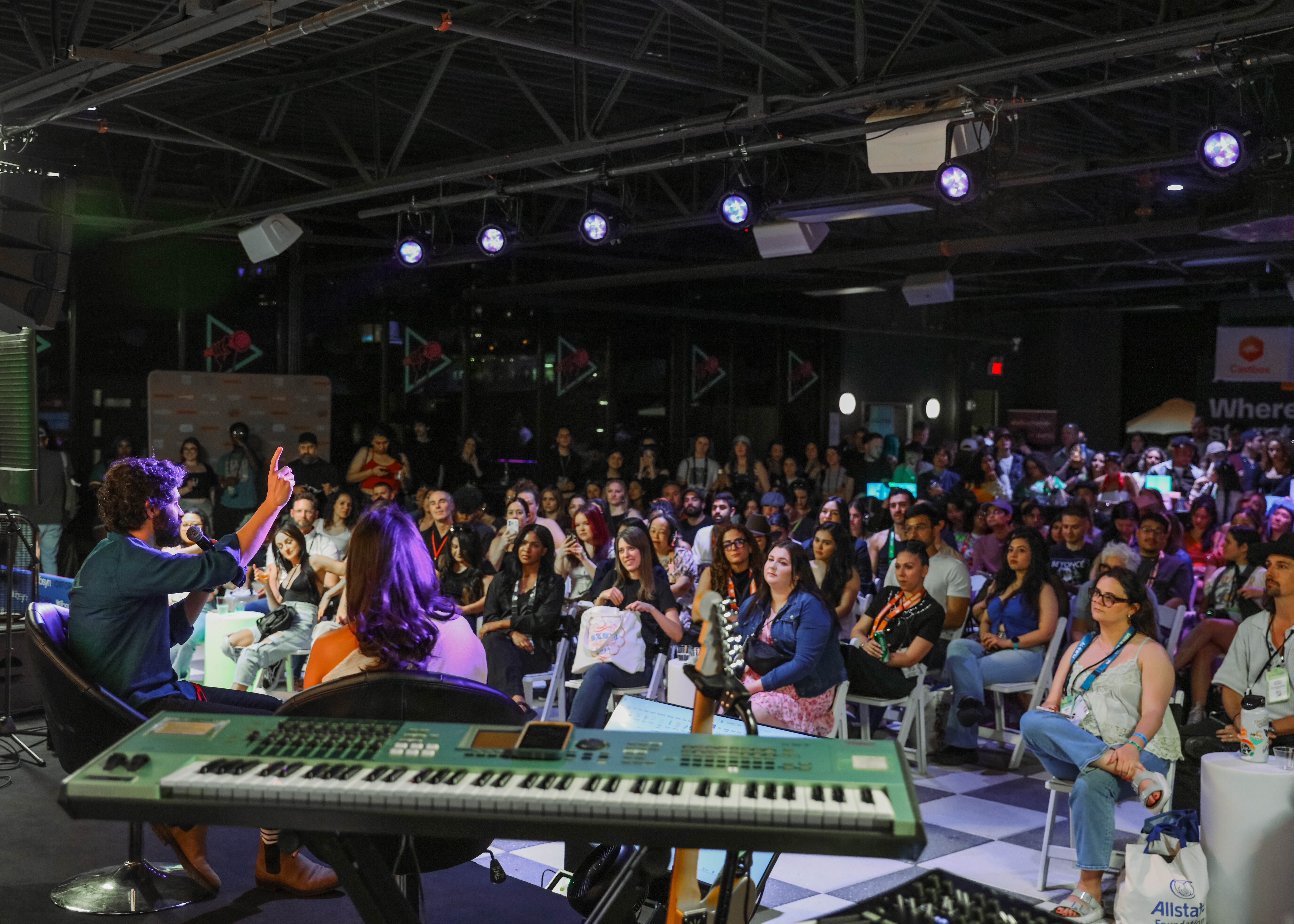
Next week, Evolutions by Podcast Movement is coming to SXSW. No extra badge or ticket needed, though pre-registration is highly encouraged. Join us for three days of curated panels, networking, happy hours, and live events with special celebrity guests. All hosted in SKYBOX on 6th, a 400-person venue with capacity for 350+ overflow in a neighboring space. See you there!
A chart from Edison Research made the rounds this week, reported by Techcrunch and others, showing that podcasting and AM/FM radio are now essentially tied in their share of spoken-word listening time. In 2015, radio claimed about three-quarters of all spoken-word audio minutes. Today, that figure sits at roughly 39%. Podcasting, which accounted for just one in ten spoken-word minutes a decade ago, now commands about 40%. Two lines, crossing inside a fixed container. The headline writes itself, and surely it did: podcasts are “neck and neck” with radio.
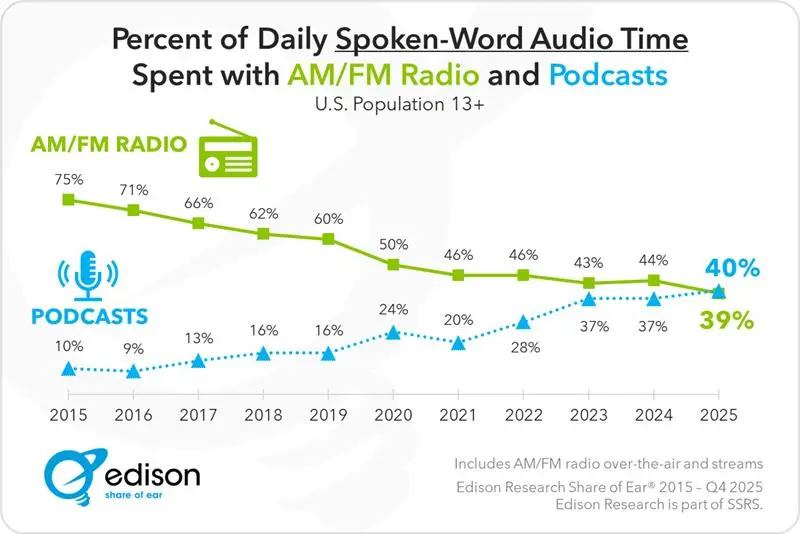
I want to be careful here because I was part of the great team that built Share of Ear. It is the only single-source measure of all forms of audio in America, and it does what it does better than anything else out there. But I know what it was built to measure, and I know where its walls are. And the story this chart tells — that podcasting just caught up to radio in spoken word — isn’t quite right. Podcasting passed radio in spoken word a while ago. This study just can’t see it.
An Audio Ruler in a Video World
Share of Ear measures audio. That’s the name on the tin: Share of Ear. It tracks the allocation of the roughly four hours per day that Americans spend listening to audio across AM/FM radio, streaming music, podcasting, audiobooks, satellite radio, and so on. Within that audio universe, it is stable and trackable.
But podcasting is no longer an audio-only medium, and it hasn’t been for some time. The most popular podcasts in America are available on YouTube. Many of them are watched on YouTube by audiences consuming the exact same spoken-word personality content that Share of Ear is carefully tabulating on the audio side. When someone watches Joe Rogan or Call Her Daddy or SmartLess, they are consuming a podcast. They may be consuming it as video. They are certainly consuming spoken word. But that consumption is invisible to an audio measurement study, because the study — by design, for very good methodological reasons — only measures audio.
Edison would rightly point out that Share of Ear is designed to capture audio consumption regardless of platform, including YouTube. And methodologically, that’s the intent. But it does rely on respondents categorizing what they did as listening, and that’s a squishy line in practice. If someone spent an hour actively watching a video podcast on their living room television, they’re likely to remember that as something they watched, not something they listened to. The survey is asking what they heard. The content is identical. The self-reporting isn’t. And that is what the survey is supposed to do.
So when the headline says that podcasting is “neck and neck” with radio at 40% of spoken-word audio time, what it actually means is that the recalled audio portion of podcast consumption — the portion that respondents themselves identify as listening — has reached parity with radio. The rest of it — the substantial, fast-growing, video-first portion — is off the books entirely. It’s not that the data is wrong. It’s that the frame around the data is too small for the medium it’s trying to capture.
This is a little like measuring the NFL’s popularity by counting only people who listen to games on the radio. You’d have a perfectly accurate measure of NFL radio listenership, and it would tell you something real about how Americans consume football. But you would be dramatically understating the actual reach of the NFL, and any conclusions you drew about the NFL’s competitive position relative to, say, Major League Baseball would be missing most of the picture. Only sports analogy in this column, I promise.
The Milestone We Already Passed
If you could somehow add YouTube video podcast consumption, Spotify video podcast consumption, and all of the other visual formats back into this chart — if you could measure all spoken-word podcast consumption regardless of whether it came through speakers or screens — podcasting probably would have passed radio’s spoken-word some time ago. Not this week. Not this quarter. Maybe even more than a year ago.
We know this because the data from our own studies makes it unmistakable. In Sound You Can See, we found that the vast majority of video podcast consumers discovered the medium in the last five years, and they did so through YouTube, TikTok, and Instagram — not through audio platforms. In The Podcast Landscape, video podcast consumers report spending roughly half their total podcast time watching rather than listening. Those are hours of spoken-word consumption that simply do not appear in the Share of Ear data, because they happened on a screen and were actively watched and not listened to through a minimized app or hidden browser tab.
So the celebration that podcasting finally caught up to radio in spoken word is really just the measurement catching up to a reality the audience figured out a while back. The audience doesn’t care whether it came through their ears or their eyes. They’re consuming the same hosts, the same conversations, the same content. They just happen to be doing it in a way that an audio survey wasn’t designed to capture.
The Lazy Causation
There’s a second trap in this chart that’s worth flagging, because I’ve seen it all over the coverage. When you look at one line going down and another going up inside the same container, your brain wants to draw a line connecting them in a direct relationship. Radio’s spoken-word share fell; podcasting’s spoken-word share rose; therefore, radio’s listeners became podcast listeners. The torch was passed. The new guard replaced the old.
I don’t think that’s what happened.
Think about what commercial AM/FM spoken-word radio actually is in 2026. It’s overwhelmingly syndicated conservative talk and personal finance programming. It’s the heirs to Rush Limbaugh’s time slot, it’s Sean Hannity, Dan Bongino, and Mike Gallagher. This is a specific, older, predominantly male audience. The median age of commercial talk radio has been climbing for years, tracking closely with the median age of cable news viewers, which is now well into the 60s.
Podcast spoken word in 2026 is true crime, comedy, sports, culture, wellness, interview shows, and political commentary across the entire spectrum. The podcast audience skews over a full generation younger than heavy radio listeners. It is significantly more diverse by gender, age, ethnicity, and interest. These are not the same people.
So where did radio’s spoken-word listeners actually go? My strong suspicion is that a significant portion of them went to cable news, which delivers the identical product — personality-driven opinion programming from familiar hosts — with the added benefit of visuals. And many probably went to TikTok, and Reels. For an older audience already spending significant time with television, that’s barely a behavior change. They didn’t leave spoken word. They left commercial talk radio. And that migration is completely invisible to an audio-only measurement, for the same reason podcasting’s video consumption is invisible: Share of Ear doesn’t measure actively watched screens.
Meanwhile, podcasting’s spoken-word growth almost certainly came from the other direction entirely — from people who had no talk radio habit, who were pulled into spoken-word content through video discovery on YouTube and social platforms, and who now toggle between watching and listening depending on context. These are new entrants, not converts.
Two independent migrations, one out of audio and one into it, happening inside the same statistical container. The graph makes them appear to show a cause-and-effect relationship. They aren’t.
What This Actually Changes
If podcasting has already passed radio in total spoken-word — audio and video combined — and the growth is coming from genuinely new consumers rather than repurposed radio listeners, then a few things follow.
First, the ceiling is higher than the spoken-word audio frame suggests. Podcasting isn’t approaching equilibrium inside a fixed pool of talk-radio minutes. It’s expanding the market for personality-driven spoken word by drawing in audiences who never had an AM dial habit.
Second, we need to stop benchmarking against radio. When you see “podcasting catches radio,” the reflex is to think you’re in a two-horse race. You’re not. The competitive set isn’t the AM dial. It’s YouTube, TikTok, Netflix, and every other claim on attention.
Third, we need to broaden the measurement frame.
Share of Ear isn’t the problem. It’s a great instrument, built with real care, and it still tells us something true and useful about how Americans allocate audio time. The issue is simply that spoken word is not confined to audio anymore. Podcasting now lives across earbuds and screens.
If we want to understand the full competitive picture, we need a framework that can see both.
Why I’m Harping on This
I can feel the eye-roll from here: why am I harping on this? Am I just being pedantic about a chart?
No.
I’m harping on it because I don’t want us ensmallifying podcasting.
When the story gets told as “podcasting finally caught talk radio,” we quietly agree to a ceiling that has nothing to do with where the audience is actually going. We frame the win as parity with a shrinking, aging, AM-dial-defined category, and we miss what’s actually happening in the market: spoken word, from storytelling to chat shows, is getting bigger, more visual, more global, and more entangled with the attention economy every year.
This is me asking—nicely, I hope—that we stop treating the radio dial as the finish line. Podcasting’s competitive set is screens and feeds and subscriptions and personalities with their own gravity. Let’s measure audio rigorously, absolutely. But let’s not tell the story in a way that shrinks the medium to fit the ruler.
Let’s aim higher.