A short one today, since this afternoon we’re presenting the results of a new study for Sounds Profitable — one we’ve been working on for a while now — called Audio Primes. The concept is simple enough to state but complicated enough to require a full webinar to unpack: not everyone who consumes podcasts does so the same way.
An Audio Prime is someone who consumes at least 75% of their podcasts as audio. A Video Prime watches at least 75% of their podcasts. These aren’t demographic labels — Audio Primes actually index slightly younger than the overall podcasting base. They’re mindset labels. And the distinction between them has implications I didn’t fully appreciate until we started cutting the data.
Here’s one example. We asked both groups how they’d react if they learned that one of their favorite podcasts featured AI-generated voices. Among Audio Primes, 48% said they’d be less likely to continue listening. Only 15% said they were more likely. That tracks with what you’d expect — audio-first listeners value authenticity in the channel they’ve chosen, and an AI voice feels like a violation of the contract.
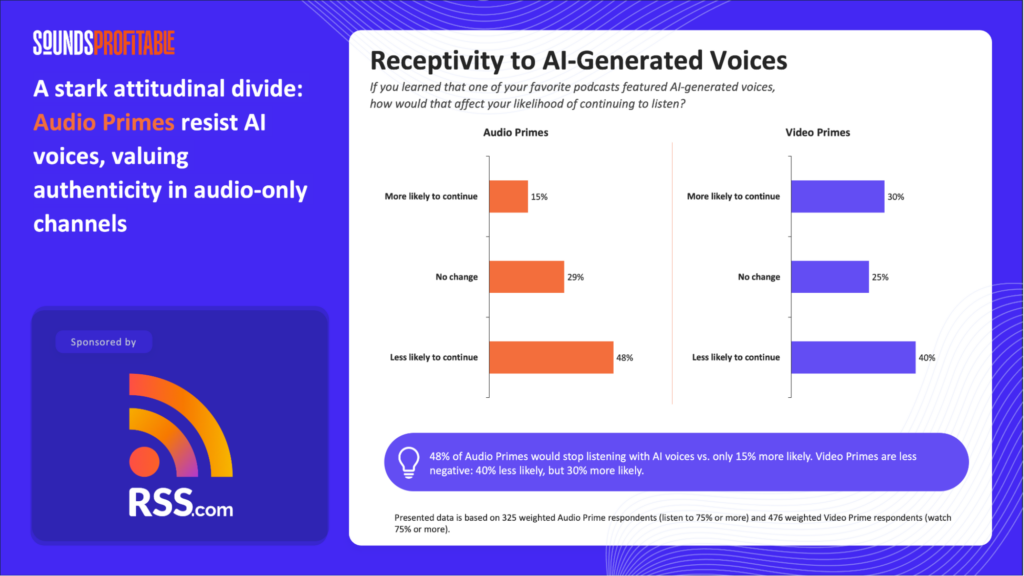
But look at the Video Primes. 40% less likely, sure — but 30% more likely. Double the enthusiasm of Audio Primes.
The easy read is that Audio Primes are resistant to AI. And they are, relatively. But that’s not actually the interesting story in this data. The interesting story is that Video Primes are receptive to it — not grudgingly, but actively. Three in ten say an AI voice would make them more likely to stick around.
I think I know why. Video-first consumers have spent the last several years swimming in synthetic content. AI influencers, deepfakes, AI-generated avatars and narrators on TikTok and YouTube — they’ve already negotiated their relationship with “this isn’t a real person, and I don’t mind.” They have a frame for it. Audio Primes don’t, or at least have less of one. When you’ve chosen audio as your primary mode of consuming podcasts, voice is the whole medium. It’s the only thing there. A synthetic voice isn’t a gimmick you can contextualize — it’s a substitution for the thing you came for.
This is what makes the Audio Primes / Video Primes distinction so useful. It’s not about age. It’s not about tech savviness. It’s about what you expect from a podcast, and those expectations shape everything — how you discover shows, how you consume them, how you react to changes in the medium, and yes, how you feel about the robots.
Today’s webinar goes much deeper than this one data point. I’ll be walking through who Audio Primes are, what makes them distinct, and what those differences mean for creators, platforms, and anyone buying or selling podcast advertising. I’ll also be joined by Alberto Betella from RSS.com, who will be presenting some fascinating neuroscience research on the power of audio — a subject he’s spent considerable time on both in podcasting and as someone with a Ph.D. in Affective Computing. Given everything we’ve just been talking about, I can’t think of a more relevant expert to bring to the table.
It’s free. Register here for Audio Primes: The People Who Listen to Podcasts — Thursday, April 16th at 1:00 PM Eastern.The underlying data of Audio Primes is drawn from The Podcast Landscape 2025. None of this research happens without the support of our full-year sponsors of The Podcast Landscape: American Public Media, BetterHelp, ESPN Podcasts, NPR, and SiriusXM, and our research partners at Signal Hill Insights. Thank you.