I’m taking a brand-new piece of research to VidCon this week, its first outing anywhere, which is not the obvious room for someone who has spent thirty years measuring how people listen. We’re calling it The Podcast Atlas, and it’s the first thing we’ve made that tries to map the whole podcast universe at once: not just audio, but the video, the clips, the social posts, and the newsletters that now travel with a show, and how a real audience moves among all of them. The finding I’m carrying into a hall full of vertical screens and ring lights is that podcasting stopped being one thing you make, and became a territory you live in, with the creator standing in the middle of all of it. VidCon gets the first look, but I am saving the best for you in a webinar on July 1 at 2pm Eastern. I mean, why not kick off your summer holiday with a fresh perspective?
So the fair question, and a couple of you have already asked it, is whether I’ve finally gone over to the video dark side. I haven’t. I’m going because the creators at VidCon are already living in that territory whether they call it podcasting or not, and most of them haven’t heard that audio belongs in their universe, too. There’s an old turf war under all of this, audio on one side and video on the other, and the Atlas is my evidence that it’s over, the way the farmers and the cowmen eventually worked out the land was big enough for both of them. (Oklahoma! has a whole song about that fight, and its actual counsel is “territory folks should stick together.” Rodgers and Hammerstein weren’t thinking about podcast discovery, but they weren’t wrong.)
If it’s all one territory now, growing a show isn’t about which side you stand on. It’s about meeting people where they already are, whoever they are. I’m going to use the under–35s today, and not because they’re the audience that matters most. If anything, the bigger opportunity may run the other way, toward the 55-plus listener I happen to be. I’m using them because they’re the clearest case of the rule: where they already are is vertical video, one corner of that bigger map and the one I want to spend today inside.
I’m not the first to plant a flag here. Our partner Hernan Lopez at Owl & Co. has been making the largest version of the case, that vertical is where the next audience gets built; the smaller one I want is the one our own discovery research makes, because it lands on anyone with a show to grow. If the listeners you want are under 35, you are going to have to get vertical.
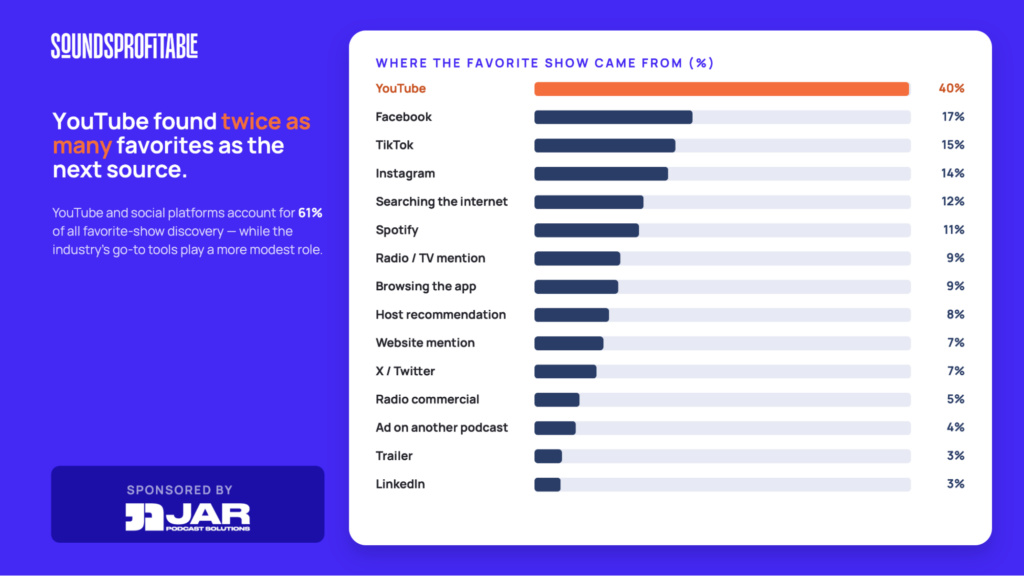
Start with what most shows still do instead. The launch kit has not changed in years: cut a trailer, line up a few host-read swaps on friendly shows, get submitted everywhere, and lobby for a shelf in the apps. Every item on that list lives inside audio or inside a widescreen frame, and every item assumes the person you want already thinks of themselves as a podcast listener looking in podcast places. The Podcast Discovery Playbook, which we published last week, asked listeners where their current favorite show actually came from. The kit lands at the bottom: the trailer at 3 percent, an ad on another podcast at 4 percent, a host’s recommendation at 8 percent. We fund those lines first and listeners credit them last.
Now split discovery by age, and the reason becomes hard to miss.
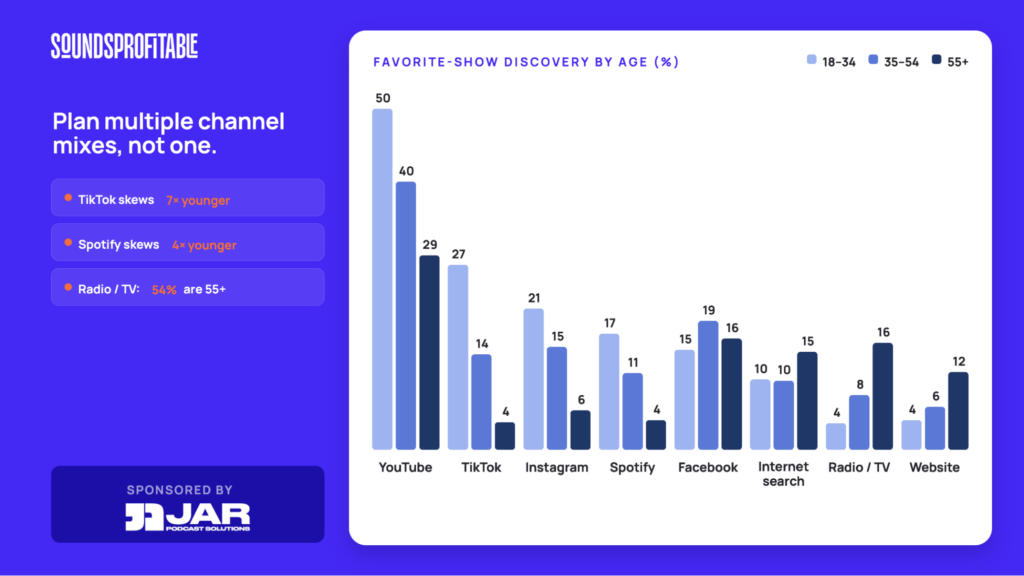
For a listener under 35, finding a show is primarily a social-video question. TikTok finds favorites for that group at seven times the rate it does for people 55 and over. Instagram and Spotify skew young in the same direction. Our read of the TikTok audience is blunt about the mechanism: vertical clips are the entry point. What gets found first is the clip, not the show. A thing shot tall, made for a thumb, watched with the sound sometimes off.
And these are not fringe audiences. The listeners who found their favorite on TikTok are 60 percent under 35 and 36 percent Hispanic, the most diverse segment in the study. The Spotify group listens close to four hours a week, near the top of the report. The young, vertical-native listener is also one of the most engaged you can reach.
This is where the easy read says “fine, the kids are on TikTok, that is a young-person problem.” It is not, and our own numbers are why I would push back. The places that find shows for under–35s are also the places where listeners are most willing to act on what they hear. Net brand receptivity, the share more likely to consider a brand advertised on a podcast minus the share less likely, runs to 58 among Spotify-discovered listeners, 55 on Instagram, and 52 on TikTok, against an all-listener baseline of 35. Eighteen-to-thirty-four-year-olds overall come in at net plus 31, ahead of the plus 27 for everyone. Those vertical surfaces reach the youngest audience and the most brand-receptive one all at once.
Our partners at Global landed in the same place from a different angle this month. Their new Podcast Show Report found Gen Z over-indexing on nearly every action a marketer cares about, from searching a brand to buying the thing, and 76 percent saying they trust a product a host recommends because the host is openly themselves. Both studies point to the same place: the young listener is no consolation prize, but an engaged and brand-receptive audience worth reaching deliberately, and right now you reach them in a vertical feed.
So what reaches them there is the next question, and the answer is not an ad. Among under–35s who found a favorite through social, 64 percent credit an organic post, someone they already follow, against 30 percent for anything sponsored. The unit of discovery is a vertical clip that belongs on the platform, made by someone who lives there. Our channel-mix guidance for this audience leads with it before anything else: vertical-clip first, with organic creators.
I should admit I am the opposite column in that table. I am 55-plus, and I find shows the old way: another podcast, a name I hear somewhere else and go looking for, a website I already read. Vertical is not where I live. The launch kit was built for me, which is exactly the problem.
None of which means the trailer is dead. It still works on the audience it was built for, the older and more audio-first listener, and on veterans, who lean on a host’s word more the longer they listen. Serving them is plain arithmetic: they’re most of the audience listening right now. It’s not a mistake to have a trailer, but a trailer is not a plan.
And there is a harder mistake underneath that one. Vertical is a medium, not a format. Being on TikTok is not the same as being native to it. A trailer turned on its side is still a trailer, and a clip that reads as a podcast advertisement gets skipped by the very people you cut it for. The reason the platform reaches the young is that good vertical does not feel like marketing, it feels like the platform doing its ordinary thing. The moment yours feels like an ad, you have shipped the failing half of the old kit on a new surface and called it new.
One more thing the report is clear about that changes the shape of the work: discovery is not a launch-week event. Half of podcast consumers went looking for a new show in the last month, and three-quarters of the people finishing a limited series go hunting for a replacement. People are shopping for the next thing all the time, which means a vertical presence is not a stunt you run at release and switch off. It is a habit you keep.
So the practical version is concrete. For a show aimed at people under 35, the launch money should not open with a trailer and a cross-promo swap. It should fund a vertical program built for the feed, made with creators who already belong there, not your back catalogue cropped tall and called native, and it should keep running long after launch week, because that is when people are actually looking. Keep the trailer by all means, for the older, audio-first audience it genuinely still reaches, but stop asking it to carry a show whose growth depends on people who are never going to see it.
Let’s get vertical. Not because the format is having a moment, but because the listeners you keep missing have already moved there, and the only show that reaches them is the one a stranger can find a single clip of, tall and sound-off in a feed, and decide to stay.
Vertical is but one territory on a much larger map. The whole Atlas is that same idea at full size: every place an audience now finds a creator and sticks with one, and how those places feed each other. I’m premiering it on a webinar July 1 at 2pm Eastern, and I’d like you there to see all of it. Save your seat.
New Partners
Sounds Profitable exists thanks to the continued support of our amazing partners. Monthly consulting, free tickets to our quarterly events, partner-only webinars, and access to our 1,800+ person slack channel are all benefits of partnering Sounds Profitable.
-
Jomboy Media is a creator-led sports media company, backed by a strategic investment from MLB.
-
The Stony Brook University Podcast Incubator is a professional training program built by working podcasters to give emerging creators and mid-career professionals the skills, tools, and community to launch shows that last.
-
Mode Mobile Group is a mobile ecosystem powering 100M+ users through EarnOS, a proprietary rewards and monetization engine that unifies high-engagement consumer apps to turn everyday screen time into income.
Want to learn more about partnership? Hit reply or send us an email!