“Sports podcasts perform” is one of those things the industry says without ever showing the work. On May 13 at 2 PM ET, Bryan Goldmark from Locked On and Tom Webster are going to show the work — the attention numbers, the trust numbers, and the actual brand campaigns those numbers translated into. Register here.
Media planners in the UK are making multi-million-pound decisions based on an outdated model that no longer reflects reality.
The model goes something like this: broadcast TV is the mass-reach medium. Podcasting is niche. If you want to reach a broad UK audience, you buy TV. If you want a smaller, more engaged slice, maybe you consider audio.
Our data says otherwise.
The 2026 UK Advertising Landscape Study — fielded in February 2026 with 5K+ UK adults, weighted to census, covering 20+ ad-supported media platforms — is the first study of its kind in the UK market. It was made possible by Sounds Profitable, who commissioned and funded the fieldwork — conducted in partnership with Sound Insights — specifically to bring the same rigour they applied to the US market to the UK for the first time.
The study replicates last year’s US Advertising Landscape Study methodology exactly, which means, also for the first time, we can make a genuine apples-to-apples comparison between both markets.
That comparison, as we’ll show across this series of posts, turns out to matter more than anyone expected.
The Numbers That Rewrite the Narrative
Broadcast TV reaches 71% of UK adults monthly. That headline number looks convincing. Until you break it down by age.
Among 18-34 year olds, broadcast TV reaches 57%. Among 35-54 year olds, 71%. Among 55+, 81%. Broadcast TV’s strength is almost entirely a story about older audiences. The medium that advertisers have historically treated as the gateway to mass reach is, for the most commercially coveted demographic, no longer the dominant force it once was.
Now look at podcasting.
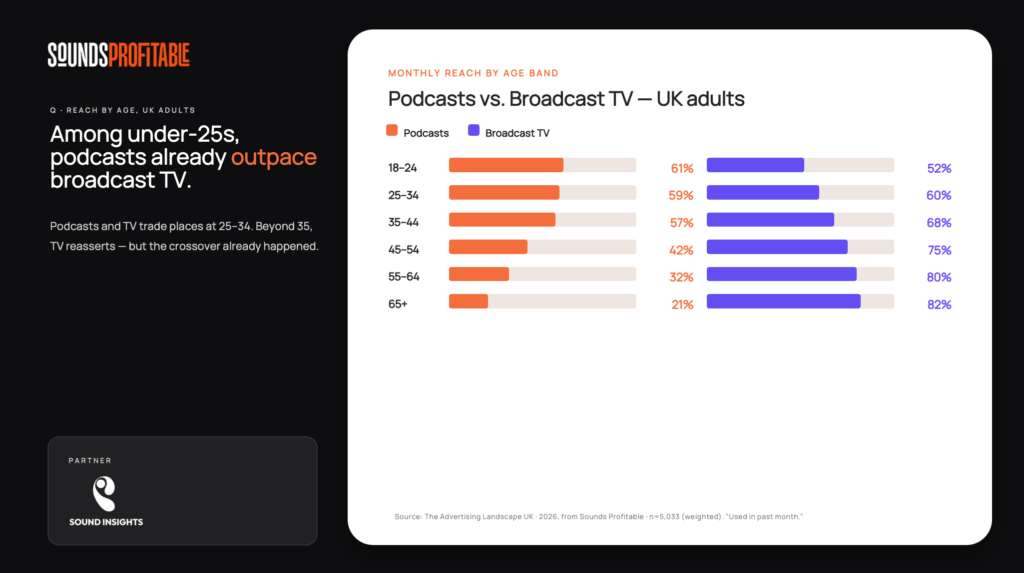
Podcasting reaches 43% of UK adults monthly. Lower overall, yes. But among 18-34 year olds? 60%.
Podcasting reaches more 18-34 year olds in the UK than broadcast TV.
In the demographic that advertisers most want to reach — the one with decades of purchasing decisions ahead of them — podcasting has already overtaken the medium that still dominates media planning conversations.
FM and DAB radio sits between the two: 47% reach among 18-34s, 65% among 35-54s, and 59% among 55+. Consistent across generations, but without the younger skew that makes podcasting’s numbers so significant.
This Isn’t an Accident
This finding doesn’t emerge from nowhere. Media analyst Evan Shapiro, speaking at MIPLondon in February 2026, documented exactly this shift from the television side. Traditional UK TV, he argued, has lost nearly a third of its four-screen audience in the last 36 months. Millennials and younger generations now make up 55% of the UK population — and their media habits are becoming the norm, not the exception.
What Shapiro describes in video, our data confirms in audio. The migration of younger audiences away from traditional broadcast is not a future risk for television. It’s a present measurable reality right now.
The 35-54 Picture: The Quiet Opportunity
Much of the attention in these conversations goes to 18-34 year olds, and rightly so. But the 35-54 finding deserves its own moment.
When we asked UK adults which media they consider among their top four most-used ad-supported platforms — what we call “Prime” users — podcasting came out at 16% for 35-54 year olds. Higher than any other age group, including 18-34s at 12%.
This is the audience with purchasing power and established habits. They’ve incorporated podcasting into their lives at a deeper level than any other age group. For advertisers targeting the UK’s most commercially active demographic, this is the signal that should be driving planning decisions.
The Shows Behind the Numbers
Headline reach figures tell you who podcasting is reaching. But ask UK listeners which shows they actually engaged with in the last month, and a sharper picture emerges.
We asked monthly podcast listeners about six well-known UK shows — The Rest Is History, The Diary of a CEO, Off Menu with Ed Gamble and James Acaster, Sh**gged Married Annoyed, That Peter Crouch Podcast, and The News Agents. The age fault lines are striking.
Diary of a CEO is the 18-34 show. 46% of younger listeners engaged with it in the past month — nearly double the 26% among 35-54s, and three times the 14% among 55+. The Rest Is History runs in almost the exact opposite direction: strongest among 18-34s, yes, but with a much flatter age curve — 55+ listeners are three times as likely to engage with it as they are with Diary of a CEO.
That pattern alone tells you something important about content strategy and audience targeting. But there’s a second dimension that matters more for advertisers.
How those listeners are consuming Diary of a CEO is not what most media planners would expect. Among 18-34 listeners who engaged with the show in the last month, they are almost as likely to watch it as listen to it. For 55+ listeners who engage at all, it is almost exclusively an audio experience.
This isn’t a podcasting story. It’s a media consumption story. The 18-34 audience that advertisers most want to reach is encountering some of the UK’s most popular podcast content through a screen as often as through earbuds. The platform boundary they’ve assumed — audio here, video there — is dissolving for younger audiences in real time.
The Rest Is History, by contrast, remains a predominantly audio experience across all age groups. Two shows, both called podcasts, consumed in fundamentally different ways by fundamentally different audiences.
We’ll return to what this means for the UK advertising landscape later in this series. For now, the point is simple: reach is just the beginning. Who is listening, to what, and through which screen — that’s where the real planning decisions live.
What This Means for Media Planners
The standard media planning conversation in the UK treats podcasting as a supplementary buy. Our data suggests that framework is already out of date.
If you’re trying to reach UK adults under 45 at scale, podcasting isn’t the niche option. In some cases it’s the primary option.
That doesn’t mean broadcast TV has lost its value — for 55+ audiences, its dominance is clear, and there are advertiser categories where that demographic is exactly right. But for brands whose customers are predominantly under 45, the old planning hierarchy needs to be rethought.
In next week’s post, we’ll explore what happens once those audiences are reached — including one ad recall finding that turns the conventional TV vs. podcast attention debate on its head.
About this study: The 2026 UK Advertising Landscape Study was commissioned by Sounds Profitable and conducted by Sound Insights. Fieldwork ran 6-17 February 2026 with n=5,033 UK adults aged 18+, weighted to census. The study covers 20+ ad-supported media platforms across four dimensions – Reach, Attention, Trust, and Effectiveness – replicating the Sounds Profitable US Advertising Landscape Study methodology for direct transatlantic comparison.
New Partners
Sounds Profitable exists thanks to the continued support of our amazing partners. Monthly consulting, free tickets to our quarterly events, partner-only webinars, and access to our 1,800+ person slack channel are all benefits of partnering Sounds Profitable.
-
StagePilot's platform, tools and production team power the internet's most-loved livestreams.
Want to learn more about partnership? Hit reply or send us an email!